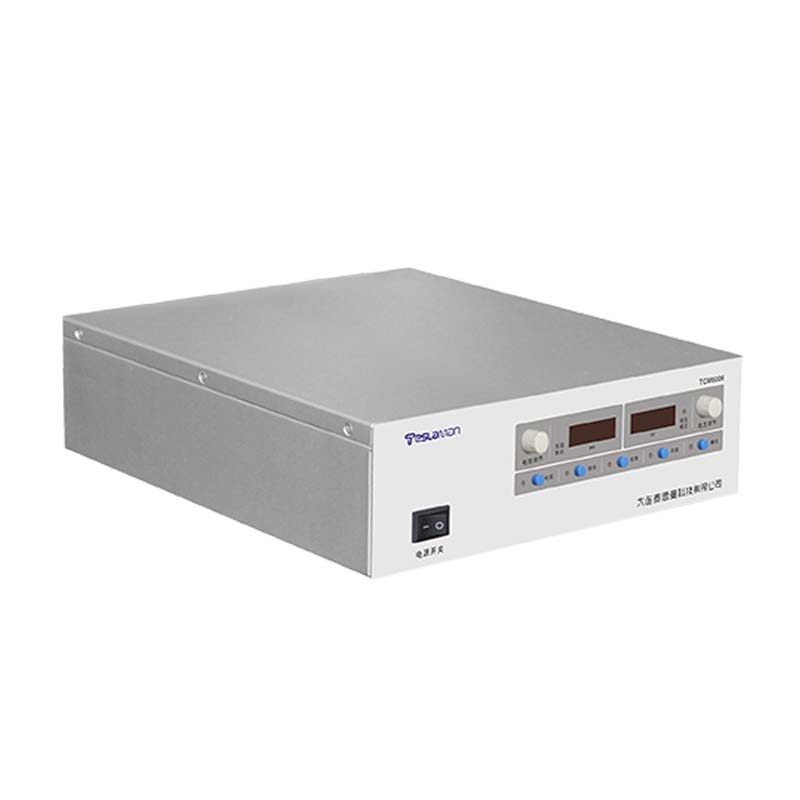
Electrostatic Flocking Three-Dimensional Curved Surface Adaptive High-Voltage Power Supply
Electrostatic flocking, the process of adhering short fibers perpendicularly to an adhesive-coated substrate, is well-established for flat surfaces. However, applying a uniform flocked coating to complex three-dimensional objects—such automotive interior trim, intricate packaging, or contoured consumer products—presents a formidable challenge. The electric field lines between the high-voltage electrode and the grounded substrate become distorted on non-planar geometries, leading to severe non-uniformity in fiber orientation and density. An adaptive high-voltage power supply system addresses this by dynamically adjusting the spatial distribution of the high-voltage field in real-time to conform to the object's shape, ensuring consistent flocking quality across the entire surface.
The core problem is field strength uniformity. In a standard setup, a single high-voltage grid (at 30-100 kV) is positioned parallel to a flat grounded surface, creating a uniform vertical field. On a curved surface, the distance between the grid and different points on the object varies. Where the object curves upward (closer to the grid), the field is stronger, attracting fibers more aggressively and potentially causing over-densification or fiber clumping. In recessed areas (farther from the grid), the field is weaker, resulting in sparse or poorly oriented fibers. The adaptive system compensates for this by creating a "conformal" electric field.
This is achieved through a programmable multi-electrode array (MEA) instead of a single monolithic grid. The MEA consists of many independently controllable high-voltage electrode segments, often arranged in a matrix. Each segment can be energized to a specific voltage or switched on/off independently. The object's three-dimensional shape is known either from a CAD model or is scanned in real-time by a 3D vision system. A control computer calculates the optimal voltage for each electrode segment to generate a resultant electric field that is as uniform as possible across the entire contoured surface of the object positioned below the array.
The power supply architecture is a massively multi-channel system. A central high-voltage DC generator provides a master high-voltage rail. This rail feeds a large array of high-voltage switching modules—one for each electrode segment or a small group of segments. Each module contains a fast solid-state switch (like a high-voltage MOSFET or IGBT) and may include a local regulating element, such as a programmable resistor divider or a small DC-DC converter, to set the segment's voltage to a specific value within a range (e.g., 20 kV to 80 kV). The switches can also pulse-width modulate (PWM) the voltage to a segment to effectively lower its average field strength. All switches are controlled by a central FPGA that receives the real-time voltage map from the shape-adaptive control algorithm.
The control algorithm is computationally intensive. It must solve an inverse electrostatic problem: given a desired uniform field at the object's surface (which is at ground potential), calculate the voltages required on the overhead electrode array. This involves modeling the capacitance matrix between every electrode segment and every region of the object. The object itself, being conductive (or coated with conductive adhesive), is an equipotential surface (ground). The algorithm iteratively adjusts the electrode voltages to minimize the variance in the calculated vertical field component across the object's surface. This voltage map is updated as the object moves on a conveyor under the array or as a robotic arm manipulates it.
Integration with the mechanical handling system is key. As the object moves, its position and orientation relative to the fixed MEA change continuously. The 3D vision system tracks this pose, and the control algorithm recalculates the voltage map in real-time (at rates of tens to hundreds of Hz). The power supply's control FPGA must update the thousands of output channels accordingly with minimal latency. Furthermore, the timing of adhesive application and fiber dispensing must be synchronized with this dynamic field shaping process.
Safety and diagnostics are critical in such a complex high-voltage system. Each channel is monitored for current. An abnormal current draw on a specific segment could indicate an arc to a sharp feature on the object, triggering that segment to shut down temporarily. The system provides a detailed map of applied voltages, allowing for process verification and traceability. By dynamically morphing the electrostatic field to match the target geometry, this adaptive power supply system breaks the traditional limitation of electrostatic processes to flat or simple shapes, enabling the high-quality, automated flocking of complex 3D products with uniform texture and appearance.