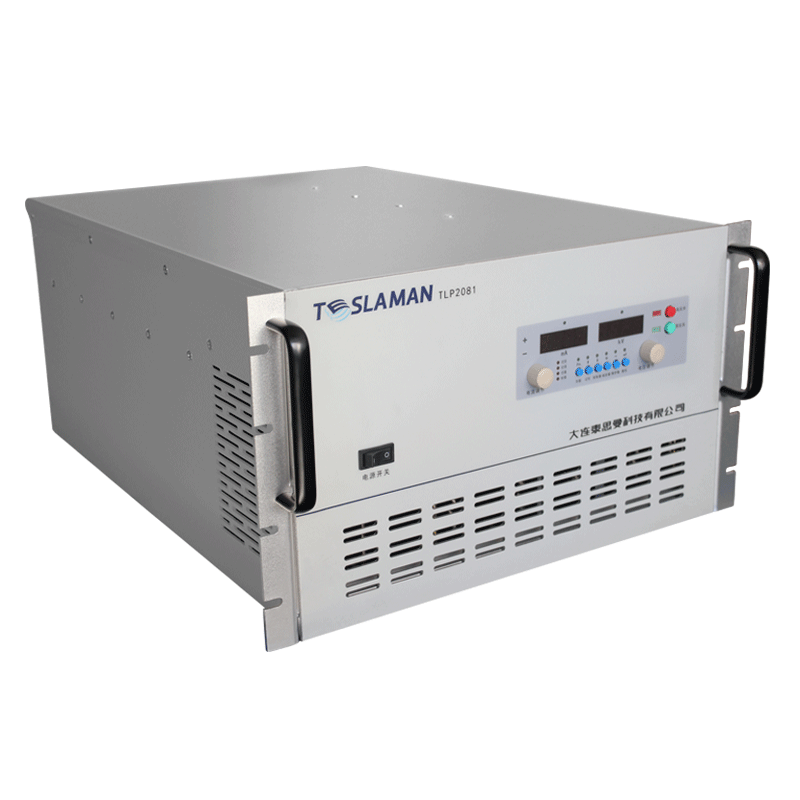
Microchannel Plate Time-Resolved Detection High-Voltage Gating Power Supply
In the realm of ultrafast diagnostics, time-resolved detection of photons or particles is paramount for experiments in physics, chemistry, and biology. Microchannel plates (MCPs), acting as fast amplifiers with high temporal resolution, are frequently employed as the core of such detectors. However, their ultimate timing performance is not solely a function of the MCP itself but is critically gated, both literally and figuratively, by the high-voltage gating power supply that drives it. This specialized supply provides the high-voltage bias across the MCP and, most importantly, delivers the ultrafast switching pulse that opens and closes the 'gate' for signal detection. The temporal window of detection can be as narrow as a few hundred picoseconds, demanding exceptional performance from the pulse generator.
The core function of this power supply is to switch a high voltage, typically between 800 and 1200 volts, on and off across the MCP input electrode with unprecedented speed and fidelity. When the gate is 'off', the MCP is biased below its electron multiplication threshold, rendering it blind. Applying the gating pulse rapidly raises the voltage above threshold, turning the MCP on. The key specifications are rise time, fall time, flat-top stability, and jitter. The transition times must be extremely fast, often targeted to be sub-nanosecond, to define a sharp temporal window. The pulse flat-top must exhibit minimal droop or ripple; any variation during the gate-open period causes a time-dependent gain shift, distorting the recorded signal intensity. Perhaps most crucially, the temporal jitter—the inconsistency in the timing of successive pulses relative to an external trigger—must be minimized to the picosecond level. High jitter effectively smears the time-resolution of the entire detection system.
Achieving these specifications requires a synthesis of high-speed circuit design, precision high-voltage engineering, and meticulous attention to transmission line theory. The pulse forming network is often based on avalanche transistor stacks, fast MOSFETs, or transmission line pulsers. The impedance of the entire output path, including cables and the MCP assembly, must be carefully matched to prevent reflections that would distort the pulse shape. The trigger input must be impeccably isolated and shielded to prevent noise from inducing premature firing. Moreover, for applications like gated imaging or sweeping streak camera operation, the power supply may need to provide not just a single pulse but a precisely timed train of pulses with variable width and delay. The design of such a high-voltage gating power supply is, therefore, a discipline at the intersection of ultrafast electronics and high-voltage engineering, enabling scientists to capture fleeting phenomena that were once beyond the reach of observation.