High-Voltage Electric Field Systems for Mixed-Fiber Separation in Electrostatic Flocking
Electrostatic flocking traditionally involves applying a uniform layer of single-material fibers to an adhesive-coated substrate. Advanced functional surfaces, however, increasingly demand hybrid flocks comprising two or more fiber types with different properties—such as conductivity, length, diameter, or color. The selective and controlled deposition of these mixed fibers to create blended or patterned surfaces introduces a significant materials handling challenge. A promising solution lies in exploiting differences in fiber electrical properties through a carefully engineered high-voltage electric field separation stage integrated into the flocking process. This system uses electrostatic forces to sort, direct, or proportionally mix fibers before they reach the substrate.
The principle relies on the fact that fibers with different physical or chemical compositions acquire different amounts of charge during the triboelectric or corona charging process in the flocking applicator. Fibers with higher conductivity may lose charge faster, while longer or finer fibers may follow different aerodynamic and electrostatic trajectories. A separation system introduces a controlled electric field zone between the fiber feeder and the substrate. This zone is not a uniform DC field but a shaped field, often created by a series of electrodes at different potentials, designed to exert differential forces on the fiber populations.
For instance, to separate a mix of conductive and dielectric fibers, one might employ a curved electrode at a high potential. The more conductive fibers, which hold their charge less tenaciously, might be influenced more by the electric field's shape and be deflected onto a different path or collected on an intermediary electrode. The dielectric fibers, retaining a stronger image charge, might follow a straighter trajectory to the primary substrate. Alternatively, to create a homogeneous blend, the field can be designed as a mixing chamber, where oscillating or rotating electric fields gently stir the cloud of fibers, ensuring a random, uniform distribution of both types before deposition.
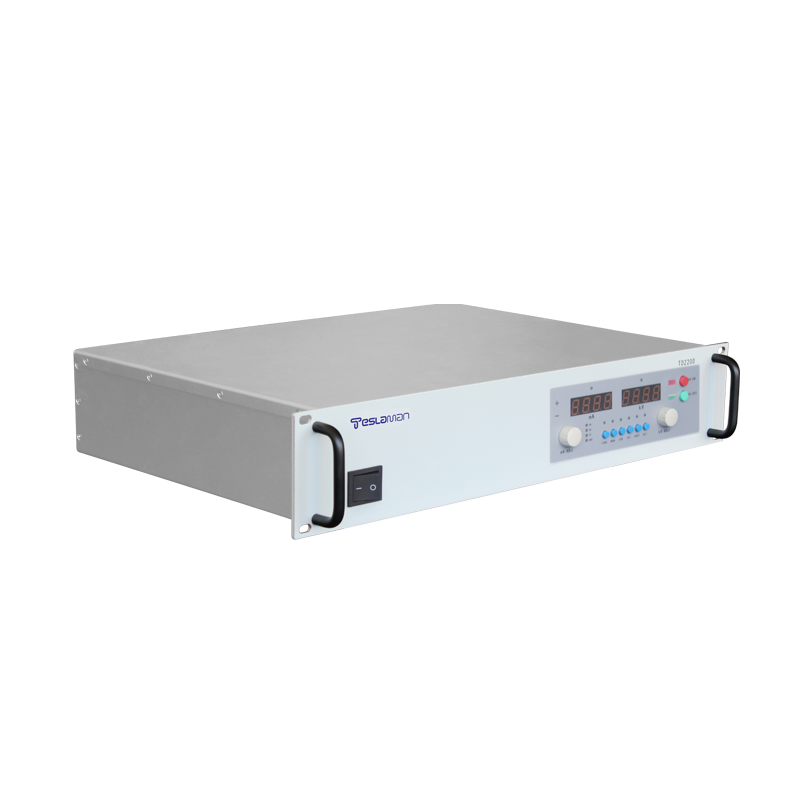
The high-voltage system required for this is multifaceted. It must generate multiple independent DC or time-varying potentials to shape the separation field. Electrodes might require voltages from 5 to 50 kilovolts, with specific spatial relationships. One electrode might be at +30 kV, another at +10 kV, and a third at ground, creating a complex field gradient. The power supplies for these electrodes must be stable and independently programmable to allow process tuning. Crucially, they must be capable of operating in close proximity without electrical breakdown, necessitating careful attention to dielectric spacing, creepage distances, and the use of insulating shrouds.
If dynamic mixing is desired, the system may need to generate alternating current high-voltage signals. This could involve sinusoidal voltages on opposing electrodes to create an oscillating field, or sequenced pulses on a series of electrodes to create a traveling wave that carries fibers along. The amplifiers for this must handle the capacitive load of the electrodes and operate at frequencies from a few hertz to several hundred hertz, depending on the desired mixing intensity and fiber transit time. The waveform purity can be important, as harmonics introduce unintended field patterns.
Integration with the existing flocking process requires synchronization. The separation or mixing field must be active and stable as fibers pass through. This requires interlocks with the fiber feed rate and the substrate motion. The high-voltage system must also be perfectly safe, as operators need to access the flocking booth for maintenance. This is achieved through physical barriers, interlocked access doors that discharge the high-voltage systems, and clear signage. Ground fault monitoring is essential, as accumulated fiber dust can create leakage paths.
Material science plays a direct role. The effectiveness of separation depends on predictable and consistent differences in fiber chargeability and charge decay rates. This requires characterization of the fiber mix beforehand. The high-voltage system's parameters—voltage levels, field geometry, and timing—are then empirically optimized for that specific material pair. An ideal system offers a user interface that allows storing recipes for different fiber combinations, enabling quick changeover between production jobs.
From an application perspective, this technology enables the creation of novel flocked products. Examples include: a velvet-like fabric with interwoven conductive fibers for static dissipation or touch-sensitive surfaces; a filtration medium with a gradient density created by separating fibers by length; or a decorative pattern with two colors deposited in a controlled blend rather than as discrete layers. The high-voltage separation stage adds a layer of material intelligence to the flocking process.
Ultimately, the development of high-voltage electric field systems for mixed-fiber separation represents a convergence of electrostatic engineering, fluid dynamics, and material science. It moves electrostatic flocking beyond the application of a uniform pile and into the realm of functional material design, where the electrical properties of the fibers themselves become a handle for their manipulation. The precision and programmability of the high-voltage field generation are what make this advanced material processing possible.