Count Rate Linearity High-Voltage Correction for Channel Electron Multipliers
Channel Electron Multipliers (CEMs) and Microchannel Plates (MCPs) are valued for their ability to detect single particles with high gain. However, their response becomes non-linear at elevated count rates, a phenomenon where the measured count rate falls below the true incident particle rate. This non-linearity stems from the temporary depletion of charge carriers within the microchannels following an avalanche event, creating a localized dead time. While the intrinsic recovery time of the channel sets a fundamental limit, the applied high voltage across the device is the primary external parameter governing both the gain and the recovery dynamics. Therefore, implementing an active high-voltage correction scheme to extend the linear range is a critical technique for applications requiring accurate quantitative measurement at high fluxes, such as in mass spectrometry of dense plasmas or intense particle beam diagnostics.
The traditional model of CEM non-linearity treats each channel as having a fixed dead time, τ. At high rates, pulses begin to overlap, leading to counting losses approximated by the paralyzable or non-paralyzable dead time models. However, this dead time is not a constant; it is a strong function of the internal space charge and the restoring electric field, which is controlled by the applied voltage, V. Following a pulse, the residual positive ions within the channel slowly drift toward the cathode. The electric field strength, proportional to V/L (where L is the channel length), determines their drift velocity and thus the time required to restore the field to a level capable of sustaining full gain for the next event.
An active correction system seeks to modulate the applied high voltage based on the instantaneous count rate to counteract this gain depression. The system continuously monitors the output pulse stream, calculating a moving average of the count rate. A predefined calibration curve, established during characterization of the specific CEM, relates the gain (or output pulse height) to both the applied voltage and the recent count history. As the detected count rate increases, the control algorithm calculates the expected gain drop if the voltage were held constant.
To compensate, the system commands a small, precise increase in the absolute value of the applied high voltage. This increased field serves two purposes. First, it directly increases the gain for the avalanches that do occur, partially offsetting the gain depression from space charge. Second, and more importantly, the stronger field accelerates the evacuation of residual ions from the channel, effectively reducing the recovery time constant. This allows the channels to reset more quickly, decreasing the probability that a subsequent event will arrive during the dead period.
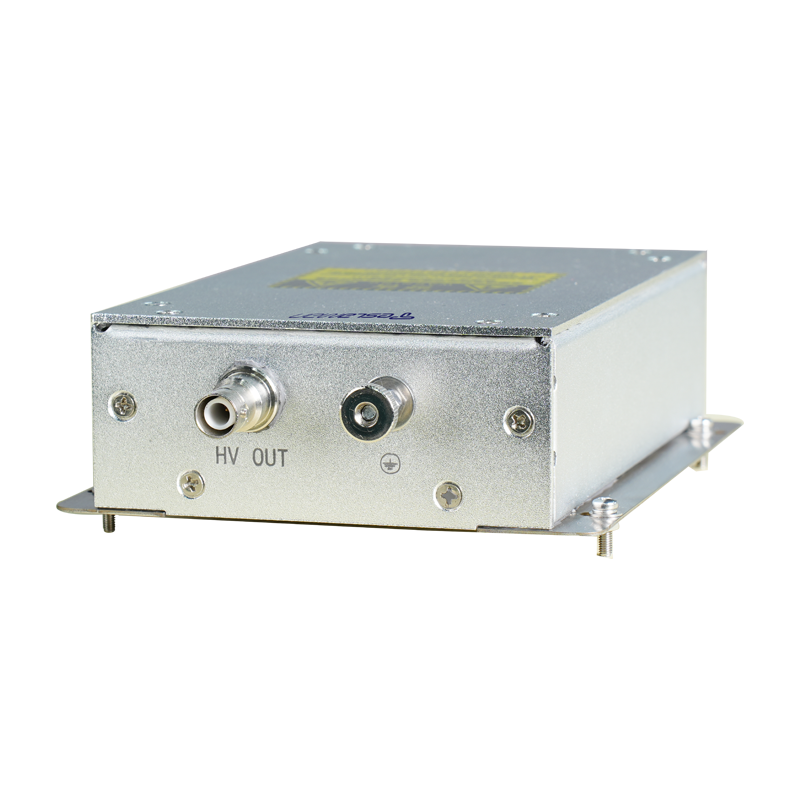
The implementation is delicate. The high-voltage power supply must have very fine resolution (sub-volt) and fast settling time to adjust its output in response to count rate changes that can occur on millisecond timescales. The control loop must be carefully designed to avoid instability or oscillations. A rapid increase in voltage in response to a sudden count rate spike could itself induce after-pulsing or instability. Therefore, the correction is often applied as a filtered, proportional adjustment rather than an instantaneous step.
Furthermore, the correction algorithm must be adaptive to the aging of the CEM. As a CEM ages and its emissive surface degrades, its gain-voltage characteristic shifts. An advanced system may periodically perform an automated gain calibration at a very low count rate to update the baseline gain curve, ensuring the correction remains accurate over the detector's lifetime.
This active high-voltage correction significantly extends the linear counting range of a CEM. Where a statically biased CEM might show 10% count loss at 10% of its maximum theoretical rate, a corrected system can maintain linearity to 50% or more. This allows for accurate particle flux measurements over a much wider dynamic range without switching between detectors or resorting to complex and error-prone dead-time correction formulas applied post-measurement. In essence, it makes the CEM a more linear, trustworthy sensor for quantitative analysis in high-flux environments, preserving data integrity in experiments where the particle flux cannot be easily controlled or predicted.