High-Voltage Excitation for Nonlinear Ultrasonic Non-Destructive Testing
Conventional ultrasonic non-destructive testing (NDT) relies on linear phenomena: the reflection and scattering of sound waves at interfaces. However, for detecting early-stage material degradation, such as micro-cracks, fatigue, or disbonds, linear methods are often insensitive. Nonlinear ultrasonic techniques exploit the fact that these micro-damage sites cause a distortion of the ultrasonic wave as it propagates, generating higher harmonics. Detecting these harmonics requires a high-power, high-voltage excitation source to drive the transmitting transducer at sufficient amplitude to induce the nonlinear material response, while simultaneously maintaining extremely low distortion in the excitation signal itself.
The fundamental principle is that a pristine material responds linearly to an incident ultrasonic wave: the output wave is a scaled replica of the input. A damaged material, with its micro-structural nonlinearities (e.g., clapping of crack faces, dislocation motion), acts as a weak frequency mixer. When driven by a single-frequency tone-burst at frequency f, the material generates waves at 2f, 3f, and other harmonics. The amplitude of these harmonics, relative to the fundamental, is a measure of the damage. The challenge is that these harmonic signals are extremely weak, often 40 to 80 dB below the fundamental. To detect them, the excitation must be both powerful and pure.
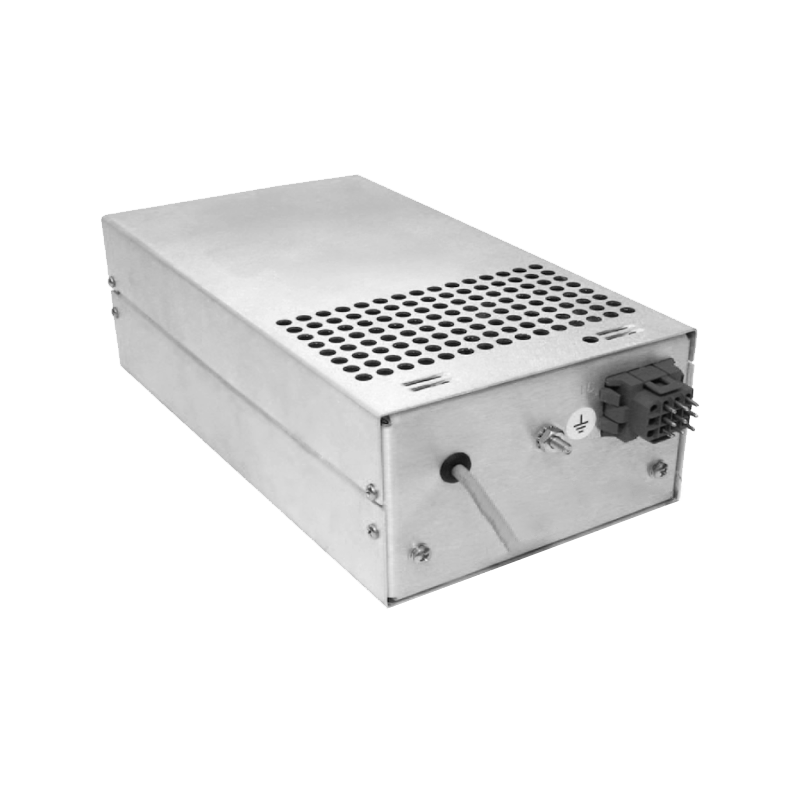
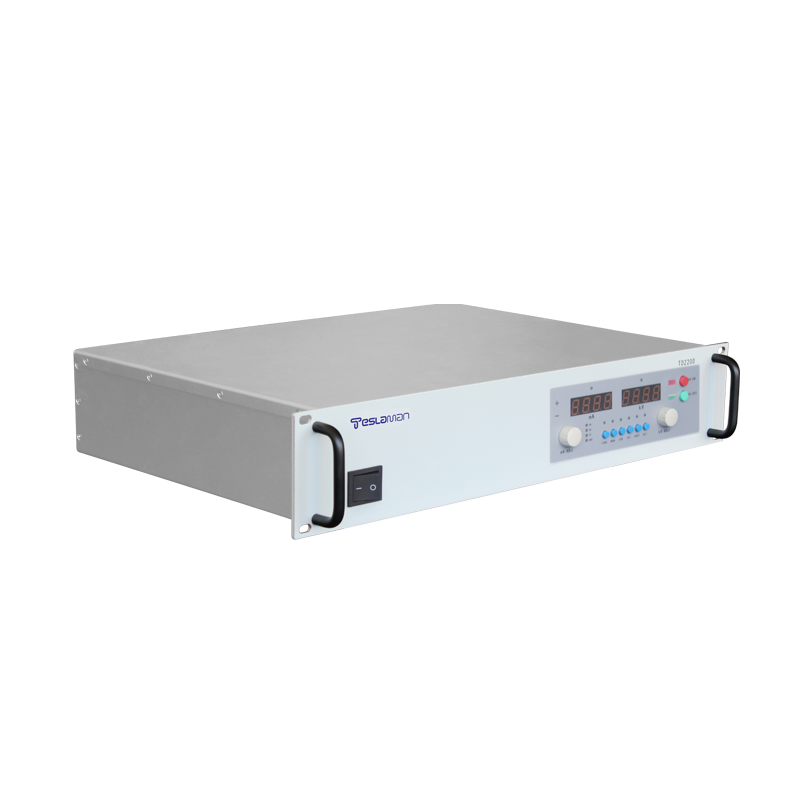
The high-voltage power supply for this application is a specialized, high-power linear amplifier or a very clean switch-mode design. It must deliver a tone-burst or a continuous wave at a frequency ranging from tens of kHz to several MHz, with amplitudes from a few hundred volts to over a kilovolt peak-to-peak. The key specification is total harmonic distortion (THD). Any distortion in the excitation signal itself will generate harmonics that are indistinguishable from those generated by the material, creating a false reading. The THD of the excitation must be lower than the expected nonlinear response, typically requiring values below 0.1% or even 0.01%.
Achieving such low distortion at high voltage and power is a significant engineering feat. For linear amplifiers, it requires massive, low-distortion output stages with extensive negative feedback. For switch-mode designs, it requires extremely fast switching, sophisticated filtering, and often the use of multi-level inverter topologies to approximate a sine wave. The output stage must drive a reactive load—the ultrasonic transducer, which is a piezoelectric device with significant capacitance. This requires the amplifier to have a high slew rate and the ability to source and sink large reactive currents without distortion.
Beyond single-frequency excitation, advanced nonlinear techniques use more complex waveforms. For example, pulse inversion uses pairs of phase-inverted pulses to cancel the linear response and enhance the even harmonics. Frequency mixing uses two primary frequencies, f1 and f2, and looks for sidebands at f1±f2. These methods require the high-voltage source to be capable of arbitrary waveform generation, with the same stringent low-distortion requirements across a wide bandwidth. This pushes the amplifier design towards a true high-voltage arbitrary waveform generator.
The detection of the nonlinear response is equally demanding. The receiving transducer signal, containing the weak harmonics, must be amplified and digitized by a low-noise, high-dynamic-range system. Synchronous detection (lock-in amplification) is often used, where the receiver is phase-locked to the excitation source. This requires the high-voltage excitation source and the receiver to share a precise, low-jitter clock.
The integration of this high-voltage excitation system with the mechanical scanning system of an NDT instrument allows for the creation of nonlinear images, or damage maps, of a component. Areas of high harmonic generation are highlighted, indicating potential damage sites long before they would be visible to conventional ultrasound. This capability is critical for the life-extension of aging aircraft, pipelines, and power plant components, where early detection of fatigue can prevent catastrophic failure. The high-voltage power supply, therefore, is not just an energy source; it is the generator of a pure, powerful acoustic probe that interrogates the very microstructure of a material, listening for the whispers of impending failure.