High-Voltage Control for Conductive Fiber Patterning in Electrostatic Flocking
Electrostatic flocking is a mature technology for creating textured surfaces, but its application has traditionally been limited to uniform coatings or simple, unpatterned fields. The demand for functional textiles and advanced composite materials, however, has spurred the development of techniques for creating precise patterns with conductive fibers. These patterns can serve as integrated circuits, sensors, or antennas directly embedded in a fabric or a flexible substrate. Achieving such patterns with electrostatic flocking requires a level of high-voltage control that goes far beyond the simple on-off switching of a uniform field. It demands a sophisticated system capable of generating complex, time-varying, and spatially non-uniform electric fields to guide individual conductive fibers or groups of fibers to specific locations on a substrate. In my half-century of work with high-voltage phenomena, I have found this application to be one of the most fascinating, as it combines the physics of charged particles, the mechanics of fibers, and the precision of modern electronics into a single, elegant manufacturing process.
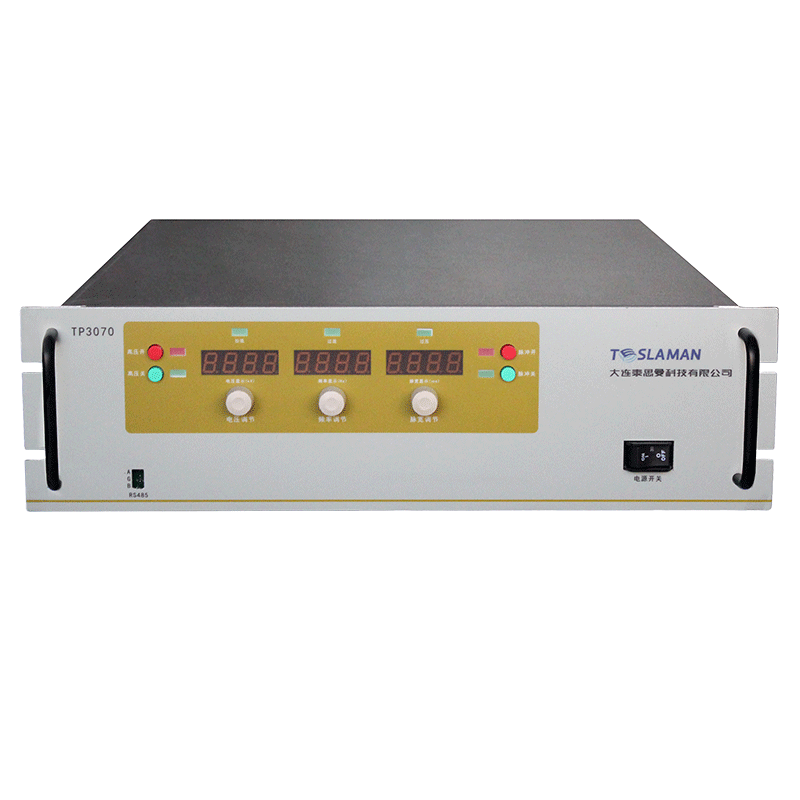
The fundamental challenge in patterning conductive fibers lies in overcoming their tendency to follow the average electric field lines. In a traditional flocking setup with parallel plate electrodes, the field is uniform, and fibers stand up and implant themselves perpendicularly across the entire surface. To create a pattern, we must break this uniformity. The most direct method is to use a shaped or segmented backing electrode behind the substrate. By applying different voltages to different segments of this electrode, we create a landscape of electric potential. The conductive fibers, which become charged in the field, will experience a force that is proportional to the gradient of this potential. They will be attracted to the regions of highest field strength, which correspond to the areas above the most highly energized electrode segments. If we want to create a line of flock, we energize a thin, linear electrode segment. The fibers will fly toward that line and implant themselves there, forming a dense, conductive trace. The high-voltage power supply for such a segmented electrode is no longer a single unit but a multi-channel system. Each channel must be independently programmable, capable of delivering a stable voltage, perhaps in the range of 10 kV to 50 kV, to its respective electrode segment. The channels must also be capable of being switched on and off rapidly, in coordination with the movement of the substrate, to build up complex, two-dimensional patterns.
The temporal control of the voltage is just as important as the spatial control. By modulating the voltage on the segments over time, we can create moving field patterns. For example, by sequentially energizing a series of adjacent segments, we can create a traveling wave of electric field that sweeps fibers across the surface, depositing them in a continuous line. This technique can be used to write patterns without the need for complex, segmented electrodes with fine pitch. The speed at which we can switch the voltages determines the resolution and throughput of the process. This requires high-voltage switches or amplifiers with a bandwidth of perhaps several kilohertz, capable of charging and discharging the capacitance of the electrode segments and the substrate. The waveform of the voltage, whether it is a simple DC level, a pulsed signal, or a more complex shape, also influences the fiber behavior. A pulsed field, for instance, can help to orient the fibers more consistently or to prevent the accumulation of charge on the substrate, which can lead to back-ionization and defects.
The properties of the conductive fibers themselves introduce another layer of complexity. Conductive fibers, whether they are metal filaments, carbon fibers, or polymer fibers coated with a conductive layer, have a different response to the electric field compared to insulating fibers. They will charge and discharge more readily, and they can also act as antennas, distorting the local field as they approach the substrate. This requires a careful calibration of the process. The voltage levels may need to be adjusted depending on the fiber conductivity, length, and diameter. In some advanced systems, a feedback loop is employed. A camera or an optical sensor monitors the deposition of the fibers in real-time, and the control system adjusts the high-voltage pattern to correct for any deviations from the desired design. This closed-loop approach allows for the creation of highly precise and repeatable patterns, even in the presence of variations in the fiber batch or environmental conditions. In my experience, the move toward patterned electrostatic flocking with conductive fibers represents a significant step forward for the field of functional textiles. It transforms a simple coating process into a true additive manufacturing technique, where the high-voltage electric field becomes a programmable tool for depositing functional materials with precision. It is a perfect example of how a deep understanding of high-voltage physics, combined with modern control electronics, can open up entirely new avenues for manufacturing the smart, flexible, and integrated devices of the future.