High-Voltage Control of Particle Trajectories in Triboelectric Separation of Plastics
The recycling of mixed plastic waste is a critical environmental challenge. Among the techniques developed to separate different polymer types, triboelectric separation stands out for its efficiency and dry nature. The process relies on charging particles through contact and then separating them based on their polarity and charge magnitude as they fall through a high-voltage electric field. After fifty years in this field, I have observed that the success of this separation is not merely a function of the charging process, but is exquisitely dependent on the precision and controllability of the high-voltage fields that guide the particles to their respective collection bins. The trajectory of a single granule is governed by electrostatics, and mastering that trajectory requires a sophisticated high-voltage power supply system.
The fundamental principle is straightforward. Particles of different plastics, such as polyethylene and polyvinyl chloride, are triboelectrically charged by contact with each other or with a charging device. One polymer type typically acquires a positive charge, the other a negative charge. These charged particles are then introduced into a free-fall chamber where they encounter a transverse high-voltage electric field generated between two large, parallel plate electrodes. The electrostatic force deflects the positively charged particles toward the negative electrode and the negatively charged particles toward the positive electrode, allowing them to be collected separately.
However, the reality of the process is far more complex. The particles are not monodisperse in size or charge. Their trajectories are influenced by their mass, their initial velocity, their charge-to-mass ratio, and the uniformity of the electric field. A particle with a low charge-to-mass ratio will be only slightly deflected and may end up in the wrong collection bin, contaminating the separated product. The role of the high-voltage power supply is to create an electric field that is strong enough to achieve a clean separation, but also stable and uniform enough to ensure that all particles of a given type follow a predictable path.
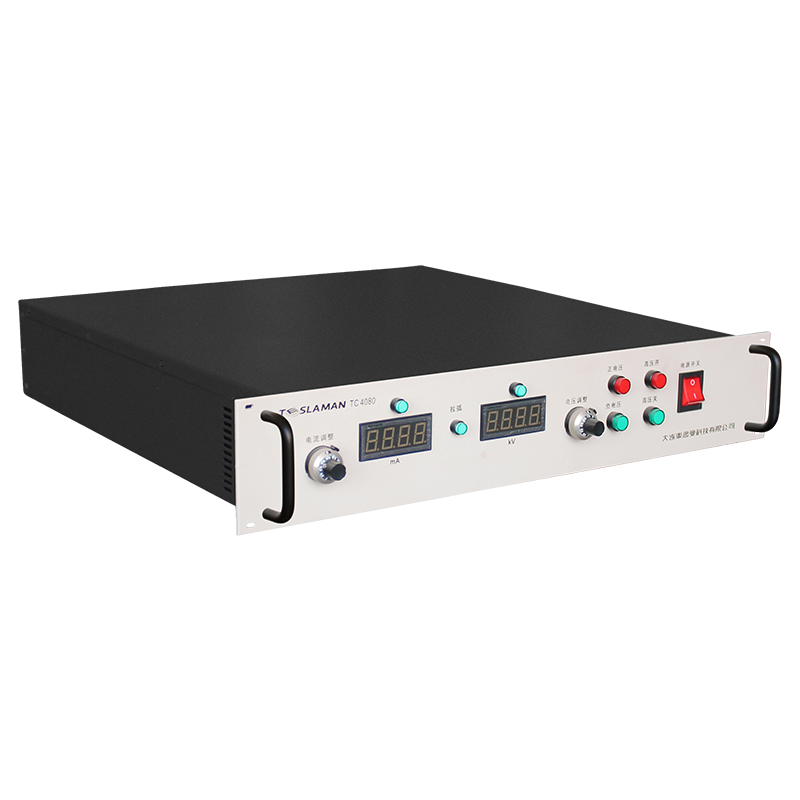
The first requirement is a high-voltage DC supply capable of generating a stable potential difference of tens of kilovolts across the electrodes. The ripple and drift on this voltage must be minimal. If the voltage fluctuates, the electric field strength fluctuates, and the deflection of the particles varies with time. This leads to a smearing of the particle trajectories at the collection point, reducing separation purity. The supply must therefore have excellent regulation, often achieved through a closed-loop control system that compares the actual output voltage to a precision reference.
Beyond simple DC stability, the geometry of the electric field is critical. The parallel plates must be large enough to create a uniform field in the region where the particles are falling. However, the edges of the plates always have fringing fields that can distort particle paths. To combat this, guard electrodes, held at intermediate potentials, are often placed around the main electrodes. These guard electrodes require their own high-voltage bias supplies, which must be precisely set to the correct fraction of the main field voltage. This creates a need for a multi-output high-voltage system where all outputs are perfectly ratioed to each other.
A more advanced approach to trajectory control involves using segmented electrodes. Instead of a single pair of large plates, the deflection field is created by an array of smaller electrodes, each individually biased. By applying different voltages to different segments, we can shape the electric field in a non-uniform way. For example, we could create a field that is stronger near the inlet to give particles an initial kick, and then weaker downstream to allow them to drift. Or we could create a focusing field that concentrates particles of a given type into a narrow beam, improving collection efficiency. This requires a multi-channel high-voltage power supply, with each channel independently programmable and synchronised. The number of channels can be significant, and the control system must manage them all seamlessly.
Another variable is the orientation of the field. While a transverse field is most common, some separators use an inclined field or a combination of fields. The particles may also be subjected to an airflow to enhance separation. The high-voltage supply must be integrated into a larger control system that also manages the air velocity and the feed rate. The trajectories can be modelled computationally, and the optimal field shape can be determined for a given mixture of plastics. The power supply then becomes the actuator that realises this optimised field in the physical separator.
The feedback for this control system can come from optical sensors. By placing a camera or a line of photodiodes at the collection plane, we can monitor the position of the particle streams in real-time. If the system detects that the stream of polyethylene is drifting towards the polyvinyl chloride bin, it can send a correction signal to the high-voltage supply, adjusting the field to steer it back. This closed-loop, real-time trajectory control is the ultimate expression of this technology, enabling the separator to adapt to changes in the input material or environmental conditions automatically.
In conclusion, the triboelectric separation of plastics is a powerful recycling technology that is fundamentally enabled by high-voltage engineering. The transition from a simple, constant-voltage system to a sophisticated, multi-channel, feedback-controlled field shaping system represents a significant leap forward in separation efficiency and product purity. It transforms the separator from a passive device into an intelligent sorting machine, where the trajectory of every particle is actively managed by a precise and responsive high-voltage power supply. This is a prime example of how advanced power electronics can contribute to solving global challenges in sustainability and resource recovery.