Integrated High-Voltage Control for Multi-Zone Thermal Management in Electrostatic Chucks
The evolution of plasma etching and deposition processes in semiconductor manufacturing has placed unprecedented demands on wafer temperature control. As critical dimensions shrink and process complexities increase, the uniformity of the wafer temperature across its entire surface has become a primary determinant of yield. The electrostatic chuck, which clamps the wafer using high voltage, has long been the platform for this thermal management, typically employing a backside gas, such as helium, to conduct heat between the wafer and the chuck surface. The heat transfer coefficient of this gas is a strong function of the gap distance, which is nominally set by the chuck's surface topography. However, to achieve the stringent temperature uniformity required for modern processes, a single, uniform gas gap is no longer sufficient. This has driven the development of multi-zone electrostatic chucks, where the backside gas pressure can be independently controlled in different radial zones. The integration of this multi-zone thermal management with the high-voltage system that provides the clamping force is a fascinating and complex engineering challenge, one that I have watched mature over the past two decades. The high voltage is no longer just for clamping; it becomes an integral part of a closed-loop thermal control system.
The principle of a multi-zone chuck is straightforward. The chuck body is fabricated with a network of gas channels that are isolated into distinct zones, typically concentric rings. Each zone is connected to its own gas supply and pressure control system. By adjusting the pressure in each zone, we can locally vary the heat transfer coefficient between the wafer and the chuck. If the center of the wafer is running hot, we increase the helium pressure in the central zone to improve cooling. If the edge is cold, we reduce the edge zone pressure. However, the implementation of this concept is complicated by the presence of the high-voltage electrodes used for electrostatic clamping. These electrodes must be embedded within the chuck body, and their layout must be carefully designed to avoid interfering with the gas channels and to ensure that the clamping force is uniform across each zone. The electrostatic force itself affects the thermal contact. A higher clamping voltage reduces the gas gap, increasing the heat transfer. Therefore, the thermal management system must be aware of the clamping voltage. In a fully integrated system, the zone pressures and the clamping voltages are controlled in a coordinated fashion by a central process controller. For example, if a zone requires a very high heat transfer coefficient, the controller might increase the clamping voltage in that zone to reduce the gap, while simultaneously increasing the gas pressure.
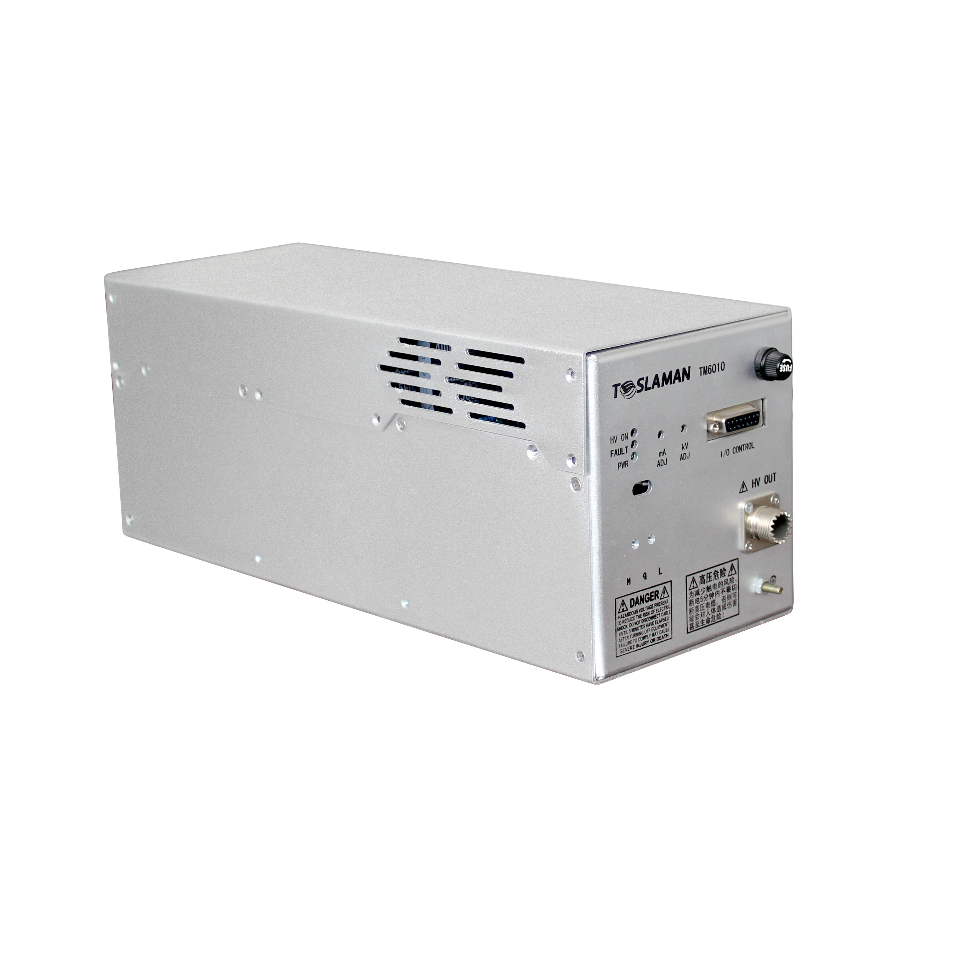
This level of integration places significant demands on the high-voltage power supply. It must be capable of providing multiple independent outputs, one for each zone, with the ability to adjust each output in real-time based on feedback from temperature sensors embedded in the chuck or from the process itself. The high-voltage electrodes in a multi-zone chuck are typically interdigitated or patterned in a way that allows for independent biasing of different areas. The power supply must be able to drive these capacitive loads without cross-talk between zones. A change in voltage on one zone's electrode can capacitively couple to its neighbor, potentially disturbing the clamping force and, consequently, the thermal contact in that adjacent zone. The supply's output stages must be carefully designed and shielded to minimize this coupling. Furthermore, the high-voltage cabling and feedthroughs into the vacuum chamber must be capable of carrying multiple independent high-voltage lines without breakdown or excessive leakage. The control system that manages this multi-variable process is a marvel of modern engineering. It must take inputs from a array of sensors, including thermocouples or fiber optic temperature sensors embedded in the chuck, and possibly from optical emission or interferometric sensors monitoring the etch rate on the wafer. A model of the thermal system, which accounts for the heat flux from the plasma, the conduction through the gas, and the conduction through the chuck, is used to calculate the required gas pressures and clamping voltages for each zone. The setpoints are then sent to the gas pressure controllers and to the high-voltage power supply. The response time of the thermal system is relatively slow, on the order of seconds, but the high-voltage supply must be able to respond to the commands smoothly and without overshoot. In my experience, the development of these integrated multi-zone chucks represents a significant leap in process control. It transforms the electrostatic chuck from a passive mechanical holder into an active thermal management device, capable of compensating for the inherent non-uniformities of plasma processes and enabling the precise temperature control required for the most demanding semiconductor manufacturing steps. The high-voltage system, in this context, is not an isolated component but a critical part of a complex, multi-physics feedback loop that ensures every square millimeter of the wafer experiences the same processing conditions.