Coordination of High Voltage Power Supply for Multi-spinneret Electrospinning of Vascular Stents
Electrospinning has emerged as a powerful technique for fabricating nanofiber scaffolds for tissue engineering applications, including vascular stents. The process utilizes high voltage to create electrically charged jets of polymer solution that solidify into fine fibers. Multi-spinneret electrospinning systems increase production throughput and enable fabrication of complex scaffold architectures. The coordination of high voltage power supplies for multiple spinnerets is essential for achieving uniform, high-quality vascular stent scaffolds.
The electrospinning process begins with a polymer solution supplied to a spinneret, which is typically a needle or capillary. A high voltage power supply applies several kilovolts to the spinneret, creating a strong electric field between the spinneret and a grounded collector. When the electric field exceeds a threshold, the polymer solution forms a Taylor cone at the spinneret tip and ejects a charged jet. The jet undergoes whipping and stretching as it travels toward the collector, thinning dramatically and solidifying into a nanofiber.
Vascular stent scaffolds have specific requirements that influence the electrospinning process. The scaffold must have appropriate mechanical properties to support the blood vessel while allowing flexibility. The fiber diameter and alignment affect cell attachment and tissue integration. The porosity influences nutrient transport and cell migration. The scaffold geometry must match the vessel dimensions and enable deployment through catheters. Meeting these requirements demands precise control of the electrospinning parameters.
Multi-spinneret systems offer several advantages for vascular stent fabrication. Multiple spinnerets operating simultaneously increase the production rate, making the process more practical for clinical applications. Spinnerets arranged around a rotating mandrel can deposit fibers uniformly around the circumference, creating tubular scaffolds suitable for vascular applications. Spinnerets supplied with different polymer solutions can create layered or gradient structures with tailored properties. The coordination of these spinnerets is critical for achieving the desired scaffold characteristics.
The high voltage coordination challenge involves ensuring that all spinnerets operate at appropriate and consistent conditions. Each spinneret requires adequate voltage to establish a stable jet, but the optimal voltage may vary depending on the spinneret position, polymer solution properties, and desired fiber characteristics. The electric fields from adjacent spinnerets interact, potentially affecting the jet behavior and fiber deposition. The coordination strategy must account for these interactions to achieve uniform scaffold properties.
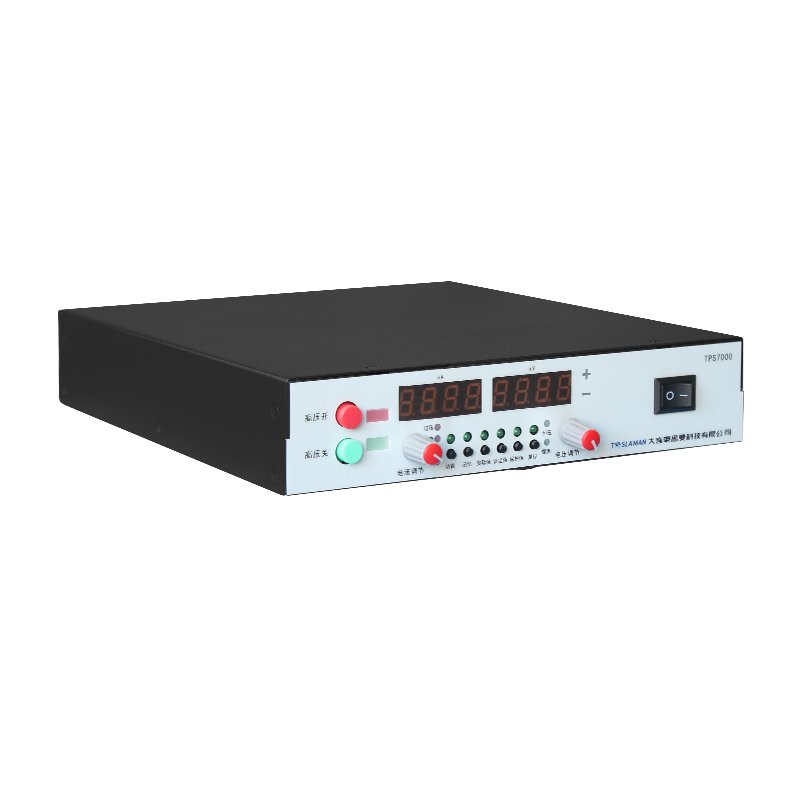
Independent voltage control for each spinneret provides maximum flexibility for process optimization. Each power supply can be adjusted to compensate for position-dependent effects and solution variations. This approach requires multiple high voltage power supplies, increasing system cost and complexity. The control system must manage the multiple power supplies and coordinate their operation for consistent results.
Shared voltage supply with individual current control offers an alternative approach. A single high voltage power supply provides the voltage to all spinnerets, while individual current regulators control the jet current from each spinneret. This approach reduces the number of high voltage power supplies while maintaining some degree of individual control. The current regulation can compensate for variations in spinneret characteristics and solution properties.
Synchronization of jet initiation and termination affects the scaffold uniformity. When electrospinning begins, the jets from different spinnerets may initiate at different times, creating non-uniform deposition at the start of the process. Similarly, jets may terminate at different times when the process stops. Coordinated control of the high voltage application ensures that all jets start and stop together, improving scaffold uniformity.
Monitoring of jet behavior provides feedback for process control. Cameras or other sensors can observe the Taylor cone formation and jet stability at each spinneret. Current measurement at each spinneret indicates the jet status and can detect problems such as clogging or unstable operation. The monitoring data enables real-time adjustment of the high voltage to maintain optimal spinning conditions.
Environmental control supports consistent electrospinning operation. Temperature and humidity affect the solvent evaporation rate and fiber solidification. Airflow patterns influence the jet trajectory and fiber deposition. The environmental control system must maintain stable conditions throughout the electrospinning process. The high voltage coordination must account for any environmental effects on the electrospinning behavior.
Scale-up considerations affect the coordination strategy for production systems. Laboratory-scale systems with a few spinnerets may use simple coordination approaches. Production systems with tens or hundreds of spinnerets require more sophisticated coordination and control. The system architecture must be scalable while maintaining the precision needed for vascular stent quality. Modular designs with coordinated groups of spinnerets can provide a practical approach for large-scale production.