Phase Synchronization Accuracy of Multi-stage RF High Voltage Power Supply for Mass Spectrometer Ion Guide
Mass spectrometry is an essential analytical technique for identifying and quantifying chemical compounds. Ion guides transport ions through the mass spectrometer from the ion source to the mass analyzer, maintaining ion transmission efficiency. Multi-stage radio frequency ion guides use alternating electric fields to confine ions radially while allowing axial transport. The phase synchronization between the RF high voltage power supplies for different stages is critical for efficient ion transmission.
RF ion guides operate by applying alternating voltages to electrodes arranged around the ion path. The most common configuration is the quadrupole, with four electrodes arranged symmetrically around the axis. Opposite electrodes are connected together and driven with voltages of opposite polarity. The resulting electric field creates a potential well that confines ions radially. The ions oscillate within this potential well as they travel along the axis.
Multi-stage ion guides consist of multiple sections with different characteristics. Different stages may have different electrode geometries, different RF frequencies, or different operating pressures. The transitions between stages can cause ion losses if the ion motion is not properly matched. Phase synchronization ensures that ions transition smoothly between stages without disruption of their oscillatory motion.
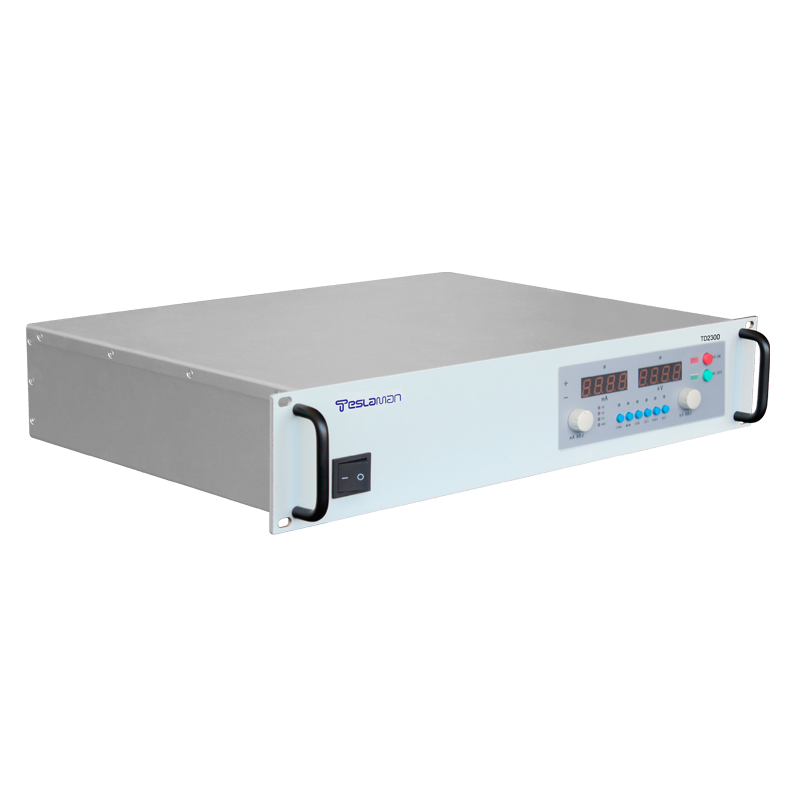
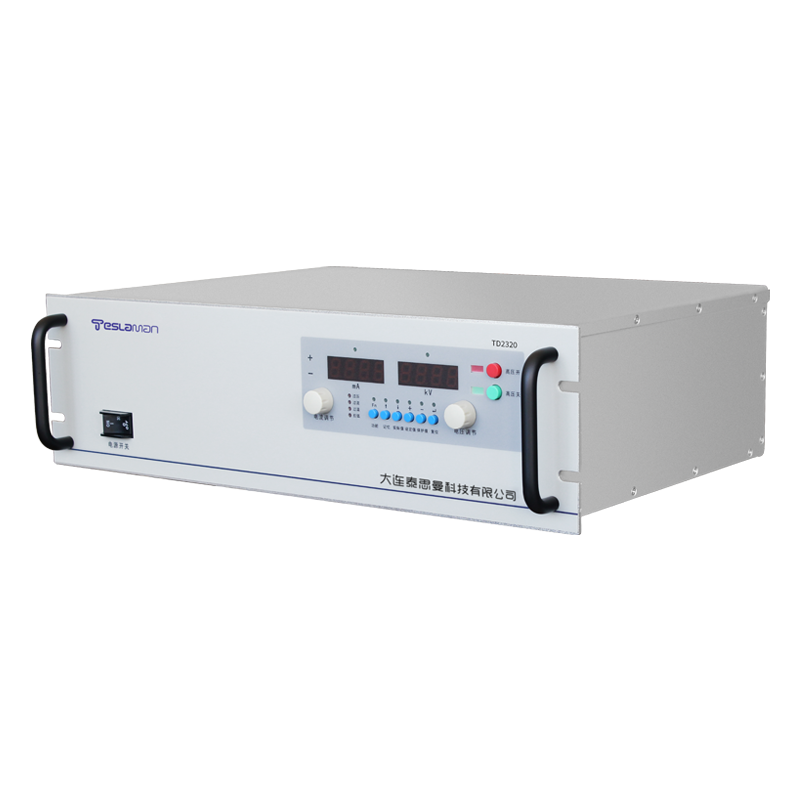
The RF high voltage power supply generates the alternating voltage for the ion guide electrodes. Typical frequencies range from hundreds of kilohertz to several megahertz, depending on the ion mass range and the electrode geometry. The voltage amplitude ranges from tens to thousands of volts, determining the depth of the confining potential well. The power supply must provide stable frequency and amplitude with low noise and distortion.
Phase synchronization between stages requires precise control of the timing relationship between the RF waveforms. When ions transition from one stage to the next, the phase of their radial oscillation depends on the phase of the RF field they experienced in the previous stage. If the RF phase in the next stage is mismatched, the ions may experience a sudden change in the confining potential, causing disruption of their motion and potential loss.
The phase relationship between stages can be controlled by driving all stages from a common RF source. The RF signal is distributed to each stage with appropriate phase shifts determined by the cable lengths and any phase shifters in the signal path. This approach ensures precise phase relationships but requires careful design of the signal distribution system.
Alternatively, each stage can have its own RF power supply with phase synchronization between them. Phase-locked loops can synchronize the frequency and phase of each power supply to a common reference. The phase of each supply can be adjusted independently to optimize the ion transmission. This approach provides flexibility but requires sophisticated control systems.
Phase synchronization accuracy is typically specified in degrees of phase error. For efficient ion transmission, the phase error should be small compared to the oscillation period of the ions in the RF field. Typical requirements may be ten degrees or less, depending on the specific ion guide design and the ion mass range. Higher accuracy may be required for sensitive applications or for ion guides with many stages.
The RF waveform quality affects the phase synchronization performance. Distortion in the waveform, such as harmonic content or asymmetry, can affect the ion motion even if the fundamental frequency is synchronized. The power supplies must generate clean sinusoidal waveforms with low distortion. Filtering can reduce harmonic content but may introduce phase shifts that must be compensated.
Temperature effects can affect the phase synchronization accuracy. Temperature changes cause thermal expansion of cables and components, changing the propagation delays and phase relationships. Temperature coefficients of electronic components can cause drift in the phase control circuits. Temperature control or compensation may be required to maintain accurate phase synchronization over the operating temperature range.
Diagnostic capabilities enable verification and optimization of the phase synchronization. Ion transmission measurements can detect phase synchronization problems through reduced transmission efficiency. Phase measurement circuits can directly monitor the phase relationship between stages. Automated optimization routines can adjust the phase settings to maximize the ion transmission. These capabilities support the setup and maintenance of the mass spectrometer.