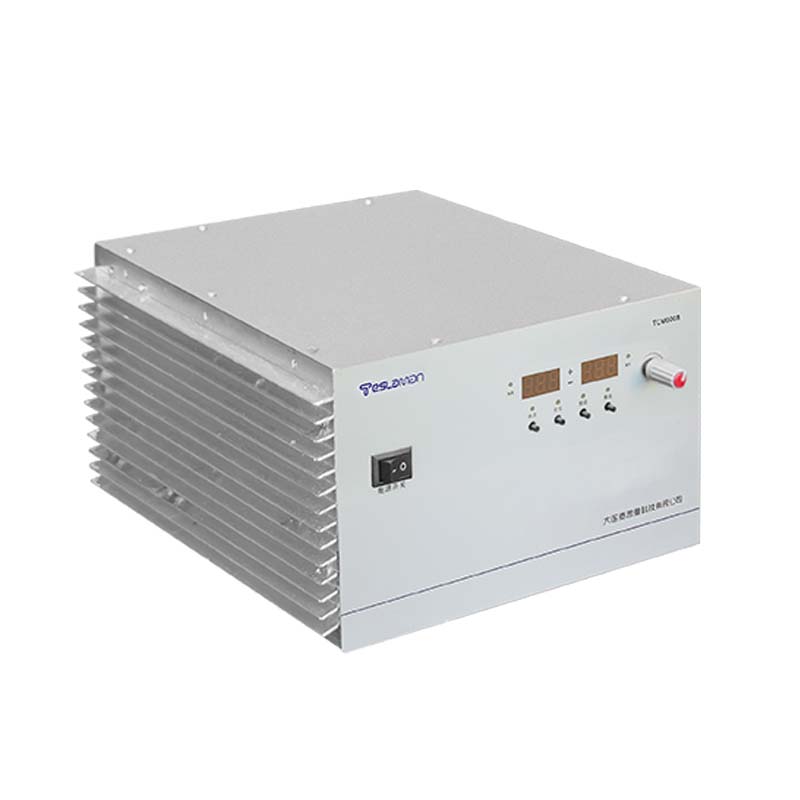
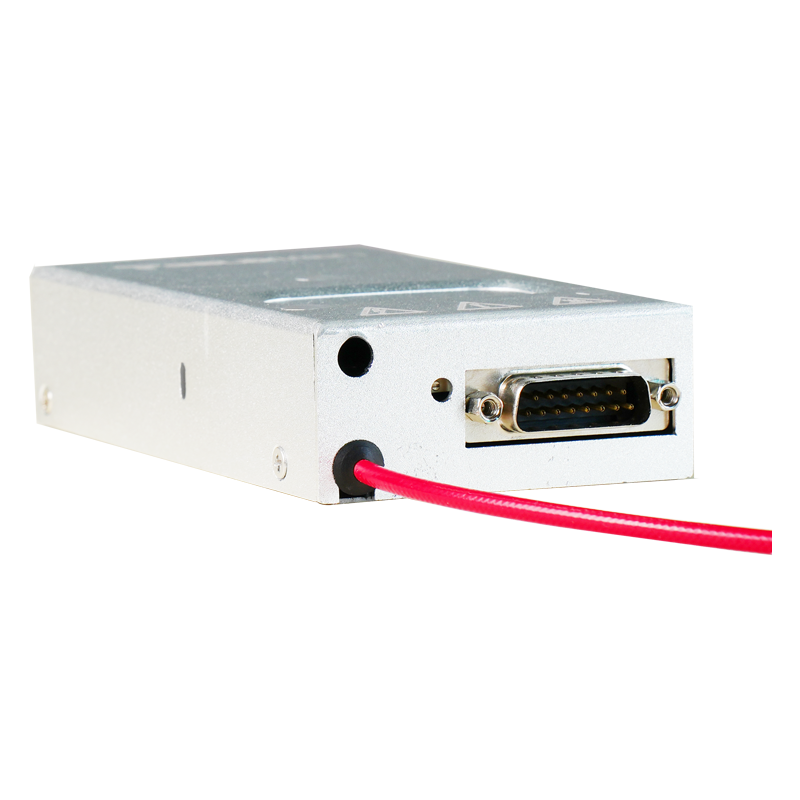
Drive Power Supply for High Voltage Tunable Light Source for Fiber Bragg Grating Sensor Demodulation
Fiber Bragg grating sensors have become widely used for measuring strain, temperature, and other physical parameters in structural health monitoring, industrial process control, and aerospace applications. The demodulation of these sensors requires precise measurement of the wavelength of light reflected from the grating. High voltage tunable light sources provide the wavelength scanning capability needed for demodulation systems. The drive power supply for these tunable sources must deliver precise, stable high voltage with the characteristics required for accurate wavelength control.
The fiber Bragg grating is a periodic modulation of the refractive index in the core of an optical fiber. The grating reflects a narrow band of wavelengths centered on the Bragg wavelength, which depends on the grating period and the effective refractive index. Changes in strain or temperature alter the grating period and the refractive index, causing shifts in the reflected wavelength. Measuring this wavelength shift enables determination of the strain or temperature.
Demodulation systems measure the wavelength of the light reflected from the fiber Bragg grating. Various demodulation techniques exist, including scanning interferometry, diffraction grating spectroscopy, and tunable filter methods. Tunable filter methods use a tunable light source or a tunable filter to scan the wavelength and identify the reflection peak from the grating.
Tunable light sources can be implemented using various technologies. Tunable lasers use external cavity designs with movable mirrors or gratings to adjust the wavelength. Semiconductor lasers can be tuned by changing the injection current or temperature. Tunable filters combined with broadband light sources provide an alternative approach. Each technology has different requirements for the drive power supply.
Electro-optic tunable filters use the electro-optic effect to change the refractive index of a crystal, thereby changing the filter transmission wavelength. Applying a voltage to electrodes on the crystal creates an electric field that modifies the refractive index through the electro-optic effect. The wavelength shift is proportional to the applied voltage. These devices require high voltages, typically hundreds to thousands of volts, to achieve useful tuning ranges.
The drive power supply for electro-optic tunable filters must provide precise, stable voltage to achieve accurate wavelength control. The voltage-to-wavelength relationship may not be perfectly linear, requiring calibration or linearization in the control system. The voltage noise and ripple must be low enough to avoid wavelength jitter that would degrade the measurement resolution.
Voltage resolution determines the wavelength resolution that can be achieved. The wavelength shift per volt depends on the specific device design and the electro-optic coefficient of the crystal material. For high-resolution measurements, the voltage resolution must be fine enough to achieve the required wavelength resolution. Digital-to-analog converters with high resolution and low noise are essential for the drive circuit.
Voltage stability affects the measurement accuracy over time. Drift in the drive voltage causes drift in the wavelength, which could be misinterpreted as sensor signal. Temperature effects on the power supply components can cause voltage drift. The power supply design must minimize temperature sensitivity or include temperature compensation.
Scanning operation requires the drive voltage to vary in a controlled manner over the tuning range. The scan waveform can be linear, sawtooth, or more complex shapes depending on the demodulation method. The scan rate affects the measurement speed, with faster scans enabling higher sampling rates. The power supply must generate the scan waveform with adequate fidelity and speed.
The speed of voltage transitions affects the scanning speed. The capacitance of the electro-optic device and the drive circuit determines the time constant for voltage changes. The drive circuit must supply sufficient current to charge and discharge this capacitance quickly. The bandwidth of the drive circuit must be adequate for the required scan rate.
Multi-channel systems with multiple tunable sources or filters require coordination between the drive power supplies. The channels may need to scan synchronously or with specific phase relationships. The control system must manage the timing and synchronization of multiple high voltage outputs. Cross-talk between channels must be minimized to maintain independence.
Protection circuits safeguard the tunable device and the drive electronics. Overvoltage protection prevents damage from excessive voltage that could cause dielectric breakdown. Current limiting protects against faults in the device or wiring. The protection response must be fast enough to prevent damage from transient events.
Integration with the demodulation system requires coordination between the drive power supply and the detection electronics. The wavelength scanning must be synchronized with the optical detection to enable accurate wavelength measurement. The control interface must support the communication protocols used by the demodulation system. The integration must maintain the precision and stability required for accurate sensor measurements.