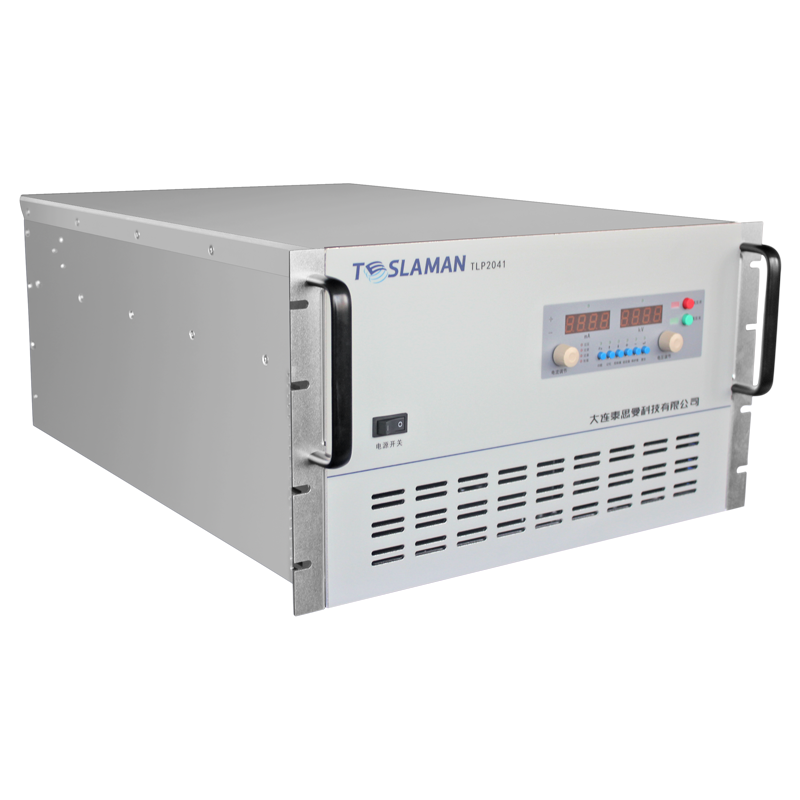
RF Harmonic Suppression of High Voltage Bias Power Supply for Inductively Coupled Plasma Etcher
Inductively coupled plasma etching systems rely on precisely controlled plasma conditions to achieve the anisotropic etching profiles essential for advanced semiconductor manufacturing. The high voltage bias power supply applied to the substrate electrode plays a critical role in determining the ion energy distribution impacting the wafer surface, directly influencing etch rate, selectivity, and profile characteristics. Radio frequency harmonic distortion in the bias voltage waveform can significantly perturb the ion energy distribution, degrading etching uniformity and introducing undesirable feature profile artifacts. Effective harmonic suppression in the bias power supply design is therefore essential for achieving the process control demanded by contemporary semiconductor fabrication requirements.
The inductively coupled plasma generates a high density plasma through RF power applied to an inductive coil surrounding the process chamber. This configuration produces plasma densities orders of magnitude higher than achievable with capacitive coupling, enabling high etch rates while maintaining independent control of plasma density and ion energy. The substrate bias electrode receives a separate RF power input that controls the energy of ions accelerated across the sheath region to impact the wafer surface. The ion energy distribution at the wafer surface depends critically on the waveform characteristics of this bias voltage, with harmonic content introducing multiple energy peaks that can broaden the ion energy distribution beyond the desired process window.
RF bias power supplies for plasma etching typically operate at frequencies of 2 MHz to 13.56 MHz, with the specific frequency selection depending on the process requirements and chamber configuration. The sinusoidal waveform from the RF generator is amplified and matched to the plasma load through an impedance matching network. Ideally, the voltage waveform at the substrate electrode would be a pure sinusoid at the fundamental frequency, producing a single peak in the ion energy distribution. However, various nonlinear elements in the power delivery chain can introduce harmonic distortion, generating voltage components at integer multiples of the fundamental frequency.
Sources of harmonic distortion in the bias power delivery system include nonlinear capacitance of the plasma sheath, saturation effects in the matching network inductors, and switching artifacts in the RF amplifier output stage. The plasma sheath presents a nonlinear capacitance that varies with the instantaneous voltage, introducing harmonic generation through the voltage dependent capacitance characteristic. Magnetic materials used in matching network inductors may exhibit nonlinear permeability at high flux densities, generating harmonic currents in the matching network. Switching RF amplifiers produce output waveforms with inherent harmonic content that may be insufficiently filtered by the output network.
The ion energy distribution resulting from a distorted bias waveform exhibits multiple peaks corresponding to the harmonic components. Each harmonic component effectively creates an additional acceleration cycle during the RF period, producing ions with energies different from those associated with the fundamental frequency alone. The resulting broadened ion energy distribution can cause several undesirable effects in the etching process. Low energy ions may contribute to isotropic etching components that undercut mask features and degrade profile control. High energy ions may cause substrate damage or excessive mask erosion, reducing selectivity and potentially creating defects that affect device performance.
Harmonic suppression techniques in bias power supply design address the various sources of distortion through targeted filtering and circuit optimization. Low pass or bandpass filtering between the RF amplifier and the matching network attenuates harmonic components before they reach the plasma load. The filter design must provide substantial attenuation at harmonic frequencies while presenting minimal insertion loss and phase shift at the fundamental frequency to maintain power delivery efficiency and matching network effectiveness. Multiple filter stages may be cascaded to achieve the required harmonic suppression while maintaining acceptable fundamental frequency performance.
The impedance matching network connecting the bias power supply to the plasma load also influences the harmonic content at the substrate electrode. Conventional L type matching networks using variable capacitors and inductors provide impedance matching at the fundamental frequency but may exhibit different transfer characteristics at harmonic frequencies. The harmonic frequencies may experience less attenuation or even amplification through the matching network, exacerbating the harmonic content at the electrode. Advanced matching network designs incorporate harmonic suppression features, including additional filtering elements or network topologies that provide matching at the fundamental while attenuating harmonics.
Active harmonic cancellation techniques offer an alternative approach to harmonic suppression by generating canceling signals at harmonic frequencies. These systems sense the harmonic content in the output waveform and drive cancellation signals through auxiliary amplifiers or injection networks. Active cancellation can provide effective suppression across a range of operating conditions and may adapt to changing harmonic generation mechanisms as plasma conditions vary. The implementation complexity and stability considerations of active cancellation systems require careful design to ensure reliable operation across the range of process conditions.
The measurement and characterization of harmonic content in bias waveforms presents technical challenges due to the high voltages and frequencies involved. High voltage probes with sufficient bandwidth and linearity enable direct waveform measurement at the substrate electrode. Spectrum analyzer measurements reveal the harmonic amplitudes relative to the fundamental, providing quantitative assessment of the harmonic suppression effectiveness. In situ ion energy distribution measurements using energy resolved mass spectrometry provide direct characterization of the process relevant impact of harmonic content, enabling correlation between waveform characteristics and etching performance.
Process dependent variations in harmonic generation complicate the specification of harmonic suppression requirements for bias power supplies. Different etching processes exhibit varying sensitivity to ion energy distribution broadening depending on the etch chemistry, mask material, and feature dimensions. Processes requiring tight ion energy control for high selectivity or precise profile control demand more stringent harmonic suppression than processes with broader process windows. The power supply design must accommodate the most demanding process requirements while maintaining acceptable performance across the range of operating conditions.
The interaction between bias power supply harmonics and plasma generation RF source introduces additional complexity when both sources operate at different frequencies. Intermodulation products between the two frequencies can create spectral components at sum and difference frequencies that affect plasma behavior and ion energy distribution. Careful frequency selection to avoid problematic intermodulation relationships, combined with appropriate filtering and isolation between the two RF systems, helps minimize these interaction effects. Some etching systems utilize the same frequency for both plasma generation and bias to simplify the frequency coordination, though this approach may limit the independent control of plasma density and ion energy.