Injection Efficiency of High Voltage Power Supply for Space Charge Measurement in Polymer Insulating Materials
Space charge accumulation in polymer insulating materials affects the electric field distribution within the insulation and can lead to accelerated aging and premature failure. Measurement of space charge distribution provides insight into the charge dynamics and the material properties that govern charge behavior. The injection efficiency of the high voltage power supply used for charge injection in measurement systems affects the amount and distribution of charge introduced into the material, influencing the measurement sensitivity and the interpretation of results.
Space charge in polymers originates from several mechanisms including electrode injection, dissociation of impurities, and polarization of dipoles. Electrode injection occurs when the electric field at the electrode interface exceeds a threshold for charge injection, typically through Schottky or hopping mechanisms. The injected charges migrate through the bulk under the applied field, becoming trapped at deep trap sites and creating space charge distributions. The injection efficiency quantifies the relationship between the applied voltage and the amount of charge injected.
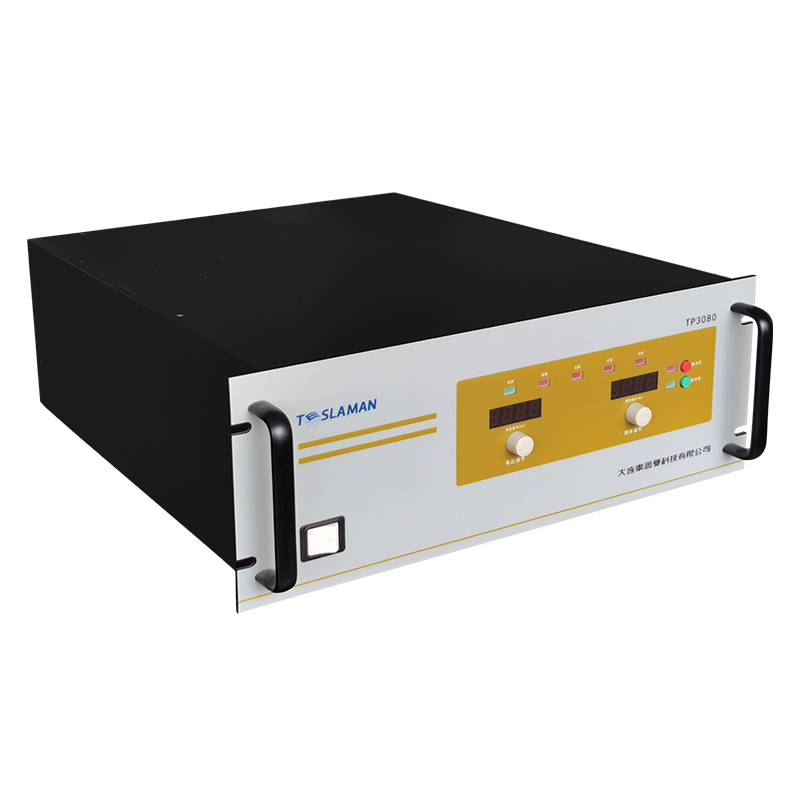
High voltage power supplies for space charge measurement must provide stable DC voltage with low ripple to maintain constant injection conditions. Voltage fluctuations would modulate the injection rate and the charge transport, complicating the interpretation of the measured charge distributions. The voltage stability requirements are particularly stringent for long duration measurements where charge accumulates over extended periods. Temperature stability of the power supply output is also important as temperature affects charge mobility and trapping.
The electrode configuration for charge injection affects the injection efficiency and the resulting charge distribution. Parallel plate electrode geometry with the polymer sandwiched between electrodes is common for space charge measurements. The electrode materials influence the injection characteristics, with different metals having different work functions and injection barriers. Blocking electrodes that suppress injection can be used to study charge generation from bulk mechanisms without the complication of injected charge.
Injection efficiency depends on the electric field at the electrode interface, which is determined by the applied voltage and the sample thickness. Higher fields produce greater injection rates, but the relationship is nonlinear due to the field dependence of the injection mechanisms. The injection current initially increases with applied field but may saturate at high fields when the injection becomes limited by transport through the bulk rather than injection at the interface.
Measurement techniques for space charge distribution include the pulsed electroacoustic method, the laser induced pressure pulse method, and the thermal step method. These techniques apply a perturbation to the sample and detect the resulting response that encodes the space charge information. The high voltage power supply provides the bias that creates the space charge distribution, while separate excitation sources provide the measurement perturbation.
The temporal evolution of space charge after voltage application provides information about charge dynamics. Immediately after voltage application, the field distribution is determined by the geometric capacitance. As charge injects and migrates, the field redistributes, approaching a steady state determined by the balance between injection, transport, trapping, and recombination. The time constants for this evolution range from seconds to hours depending on the material and the temperature.
Temperature control during space charge measurement is important because temperature strongly affects charge mobility and trapping. Elevated temperatures increase mobility and accelerate the charge dynamics, enabling faster measurement but also potentially changing the charge distribution. The power supply and measurement system should include temperature control to maintain defined measurement conditions or to enable controlled temperature variation for studying temperature effects.
Calibration of space charge measurement systems establishes the relationship between the measured signals and the actual charge distribution. Calibration samples with known charge distributions, such as samples with surface charge or samples with known dipole polarization, provide reference measurements. The calibration accounts for the measurement system response including the sensitivity, the spatial resolution, and any systematic errors.
Data analysis for space charge measurements involves solving inverse problems to recover the charge distribution from the measured signals. The signal processing must account for the measurement physics, the system response, and the noise characteristics. Regularization techniques stabilize the inversion against noise amplification. The analysis software should provide uncertainty estimates for the recovered charge distribution to enable meaningful comparison between materials and conditions.