











Electrostatic Flocking High-Voltage Power Supply Voltage Effects on Flock Uniform Distribution and Adhesion: Experimental Rules
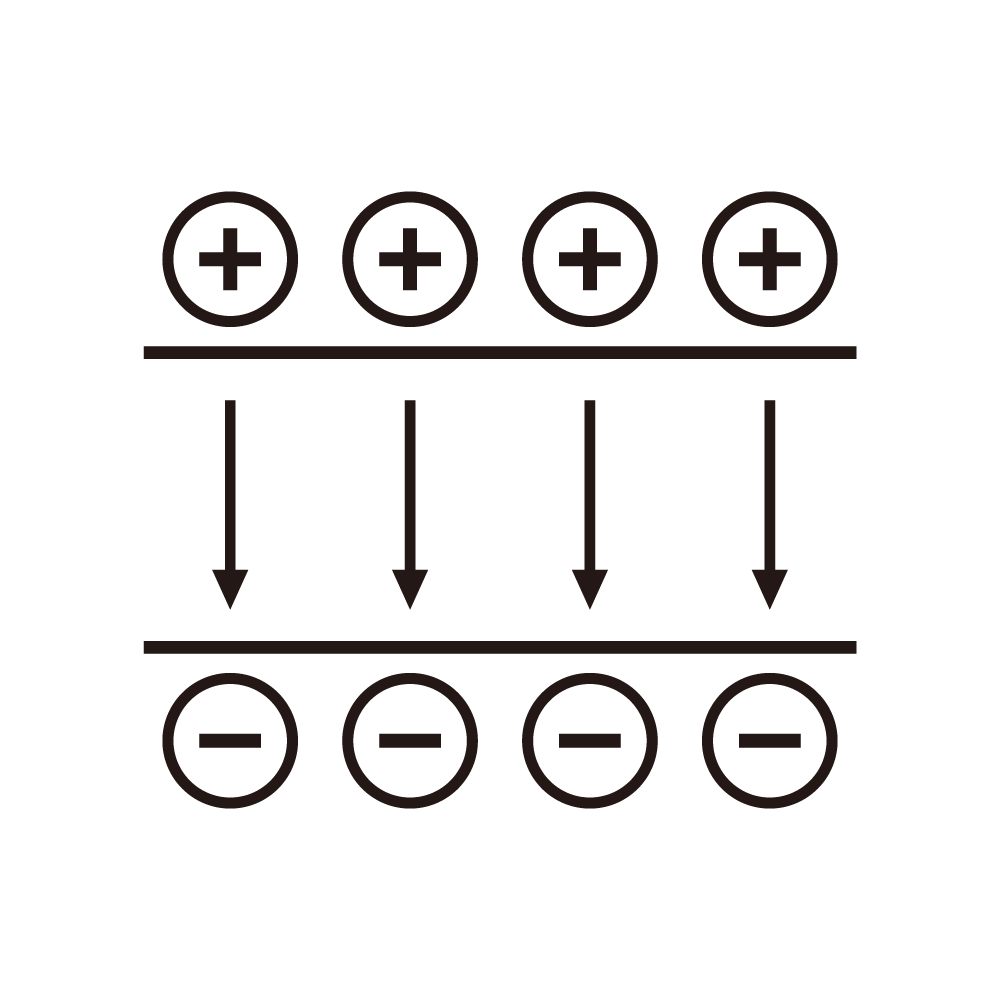
Electrostatic flocking applies short fibers to an adhesive-coated substrate under a strong electric field, and the supply voltage governs both the lift of the fibers and the orientation with which the fibers land. Experimental work on flock density and adhesion reveals a clear relationship between applied voltage, fiber charge and the uniformity of the finished pile, and the rules derived from these tests translate directly into production settings.
Fiber lift begins when the charge on each fiber produces an electrostatic force exceeding gravity and drag. Raising the supply voltage increases the force, but beyond a threshold the fibers accelerate so fast that the fibers bounce on impact and lie down instead of standing upright. Trials on nylon flock show an optimum band roughly ten percent wide where vertical orientation peaks, and operation outside that band degrades appearance faster than any adhesive variable.
Adhesion strength depends on how deeply the fiber penetrates the wet adhesive before curing. Deeper penetration requires enough kinetic energy at impact, which the voltage provides, yet excessive energy drives the fiber through the adhesive into the substrate and reduces the anchoring bond. The voltage is therefore set jointly with adhesive viscosity, and changing either parameter without retuning the supply produces measurable pull-strength variation.
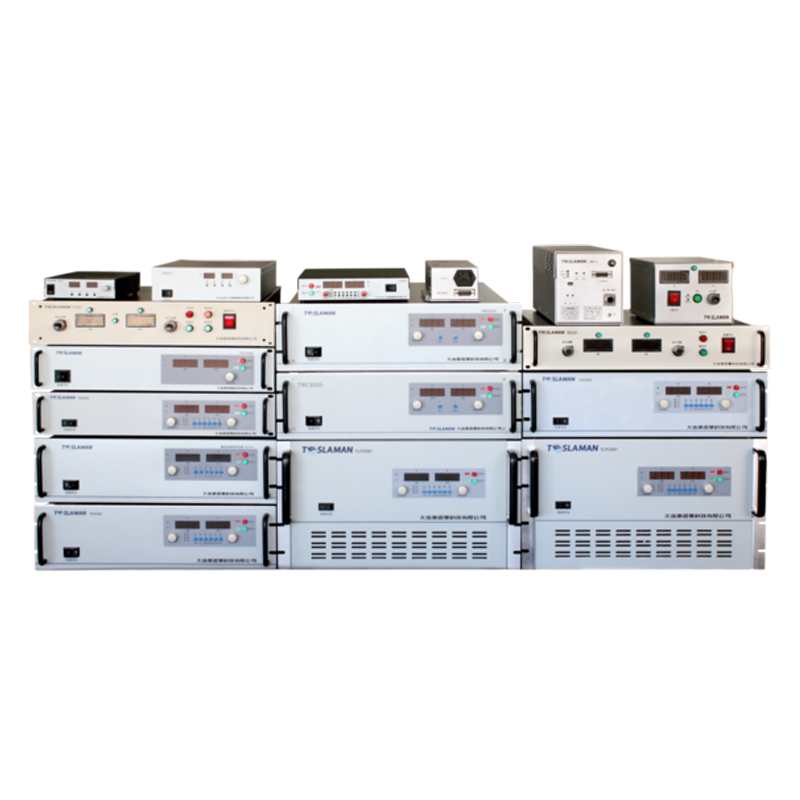
Uniformity across the substrate width is controlled by electrode geometry as much as by voltage amplitude. A single high-voltage electrode creates field falloff at the edges, so production machines use segmented electrodes with individually adjusted feeds. The supply provides several regulated outputs whose voltages are trimmed so the measured pile density stays within a tight band from edge to edge.
Pulse operation adds another control axis. Short high-voltage pulses refresh the charge on fibers already in flight, which improves lift consistency in high-speed machines. Pulse frequency and duty cycle are adjusted with the conveyor speed; tests show that a fixed pulse pattern tuned for one line speed loses uniformity when the speed changes by more than fifteen percent.
Environmental humidity acts as a competing variable. High moisture lowers fiber resistivity and accelerates charge decay, so the effective charge per fiber falls even at constant voltage. Production rules therefore link the voltage setpoint to the measured relative humidity, and the control system applies a correction curve derived from the same experimental series that established the optimum band.
Surface contamination on the flocking electrode shifts the discharge characteristics over time. Fluff and adhesive mist accumulate and create leakage paths that steal charge from the working area. Scheduled cleaning restores the field distribution, and the supply current readback gives an early sign that cleaning is due, because leakage current rises while the output voltage stays unchanged.
Long-run repeatability of the pile quality depends on the voltage reference rather than on the absolute setting. The internal reference drifts slowly with temperature, and the compensation network holds the output within tolerance across the operating range. Quarterly verification against a calibrated divider catches slow drift before the drift shows up as a customer complaint about pile density.
Preventive maintenance scheduling follows the operating hours recorded by the supply itself. The maintenance tasks are grouped by interval, and the short-interval tasks are performed during the regular downtime windows. The long-interval tasks are planned into the annual shutdown. The maintenance history is kept with the equipment and reviewed when the interval policy is updated.
Calibration management covers the measurement channels used by the supply and the instruments used to verify the supply. Each channel has a calibration interval and a tolerance, and the calibration records are traceable to the laboratory standards. The calibration status is checked before a critical measurement campaign starts.
Documentation control ensures that the drawings, the manuals, and the configuration records reflect the installed equipment. Any modification is documented with the change reason and the verification result. The document set is reviewed at planned intervals, and the obsolete versions are archived rather than discarded.
Spare parts management matches the stock level to the failure statistics of the equipment family. The fast-moving parts are kept on site, and the slow-moving parts are sourced on demand. The stock review is performed quarterly, and the review data include the part cost and the delivery lead time.
Safety procedures around the high-voltage equipment are written, reviewed, and rehearsed. The procedures cover the access control, the discharge sequence, and the use of personal protective equipment. The rehearsal results are recorded, and the procedure is revised when the rehearsal reveals a gap.
Environmental control in the equipment room stabilizes the operating conditions of the supply. The temperature and the humidity are monitored continuously, and the alarm thresholds are set to protect the insulation and the electronics. The environmental records are kept alongside the equipment log for the correlation analysis.
Data analysis turns the logged operating data into maintenance decisions. The voltage, current, temperature, and alarm trends are reviewed at planned intervals, and the deviations from the baseline trigger an investigation. The analysis report is shared with the engineering team and the maintenance crew.
Reliability assessment uses the field data collected from the equipment population. The failure rate, the repair time, and the availability are computed over a rolling period, and the results are compared with the design targets. The assessment output feeds the capital replacement plan and the spares strategy.
Energy efficiency of the supply affects the operating cost and the cooling load. The efficiency is measured at the representative operating points, and the improvement opportunities are evaluated against the implementation cost. The efficiency records are maintained for the lifetime comparison.
Training programs for the operating and maintenance staff are scheduled at defined intervals. The training covers the safe operation, the routine checks, and the fault diagnosis flow. The training effectiveness is verified with a written test and a practical exercise, and the results are filed with the personnel records.
Process qualification is performed whenever the equipment or the process recipe changes. The qualification plan defines the test articles, the acceptance criteria, and the data to be recorded. The qualification report is approved before the new condition enters production.
Failure analysis follows a defined path from the symptom to the root cause. The analysis uses the logged data, the physical evidence, and the repair records. The analysis conclusion is documented with the corrective action, and the corrective action is verified after implementation.