






极性可切换高压电源在静电分选与喷涂设备中的切换
A polarity-reversible supply is two supplies in one enclosure with a shared control, and the difficulty is not in producing either polarity but in moving from one to the other without leaving charge behind.
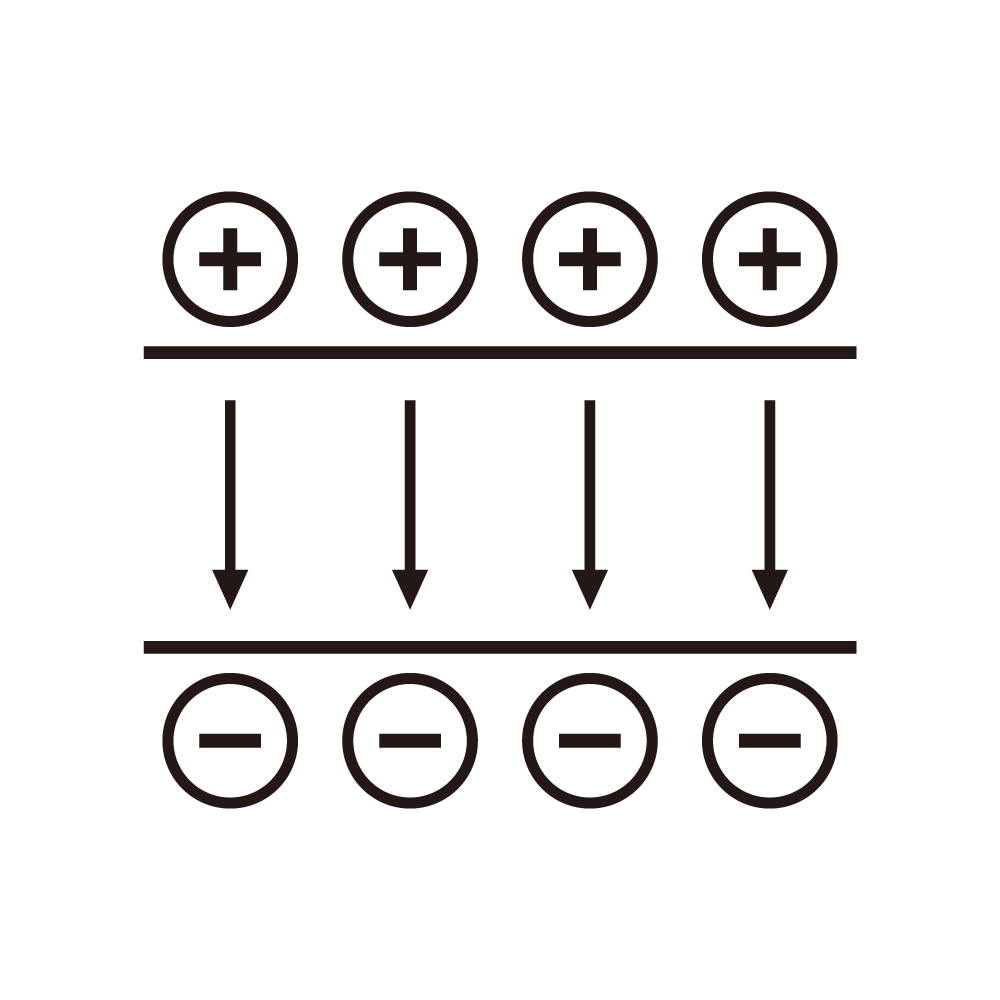
Electrostatic separation is the application that makes the requirement explicit. A mixture of materials is charged by friction or by corona, then passed through an electric field that deflects the particles according to their charge-to-mass ratio. Different materials charge with different polarity, so the field must be reversed between passes.
The reversal is not instantaneous in a physical sense. The field's electrode and the surrounding structure form a capacitance, and that capacitance holds charge at the moment of reversal. If the supply simply swaps its output connection, the capacitance discharges through the switch and produces a current pulse that can weld a contact.
The standard technique is a sequenced reversal. The supply first brings the output to zero through a controlled ramp, then waits for the discharge to complete, then reverses the connection with the switch, then ramps up in the new polarity. The whole sequence takes a defined time, typically tens of milliseconds.
The switch itself is the reliability item. Mechanical relays with a high-voltage rating are slow and wear out, while solid-state stacks are fast and leak. A hybrid arrangement, a solid-state stack for the fast transition and a mechanical relay for the steady state, gives both speed and low leakage.
Leakage in the off state matters in separation because the field must be off during the reversal. A solid-state stack that leaks a few microamperes at four hundred volts will leave a residual field, and a particle that passes during the reversal will be deflected by that residual.
The measurement of residual is straightforward. A electrostatic voltmeter, or a field mill, placed where the particles pass, reads the residual field after the reversal command, and the reading should fall below a defined threshold before the conveyor is allowed to advance.
Coating applications use the same hardware with a different timing. A gun that sprays a charged coating onto a substrate may need to alternate polarity to coat both sides of a part, or to neutralise charge that has accumulated on the substrate.
Neutralisation is the more delicate use. Reversing the polarity periodically prevents the substrate from charging to a potential that repels the droplets, and the reversal must be slow enough that the spray pattern does not flicker and fast enough that the charge does not build.
A flicker in the spray appears when the reversal is too fast. The droplets already in flight are deflected by the changing field, and the deposit becomes streaked. A reversal period of a few seconds is typical for a conveyorised line, and the ramp is set so that the field changes by no more than a defined rate.
Safety in polarity reversal is a discipline of its own. A supply that can produce either polarity must be treated as a supply that is live in either state, and the discharge indicator must show the actual potential rather than a logic state.
An indicator that reads a relay contact rather than the output voltage will show safe while the capacitance is still charged, and that is the failure that injures people. The indicator should be driven by a divider on the output, with its own redundant path.
Interlocks around the reversal must prevent the switch from operating under load. A relay that opens a four-hundred-volt direct current with a few milliamperes will arc, and the arc erodes the contacts. The sequence must guarantee that the current is zero before the switch moves, and that guarantee comes from a measurement rather than from a timer.
A separation plant case illustrates the timing. A plant separating mixed plastics reversed polarity between passes and found that the first few kilograms of each pass were contaminated. The residual field after the reversal was the cause, and the fix was to add a verification step that measured the field before the conveyor restarted.
A second case involved a coated part with a stripe of thin film. The reversal period was synchronized with the conveyor's pitch, so the reversal happened at the same position on every part, and the film was thin where the field changed. Making the period asynchronous with the pitch spread the thin region over the part instead of concentrating it.
A third case involved a relay that failed after a year. The contacts had been opening under load because the sequence's current-zero check was based on a timer rather than on the current sensor, and the timer had drifted. Replacing the timer with a comparator on the current sensor extended the relay's life to several years.
Commissioning should include a reversal timing test. The output is monitored with a high-voltage probe through a full sequence, and the time from command to zero, the dwell at zero, and the time to full voltage in the new polarity are all recorded.
The recorded times become the baseline. A supply that takes twice as long to reach zero a year later has a bleeder problem, and one that takes twice as long to rise has a loop problem, and both are diagnosable from the record.
Maintenance focuses on the switch and the divider. The relay's contact resistance is measured quarterly, the solid-state stack's leakage annually, and the divider's calibration annually.
Spares are few: one relay, one solid-state stack, one divider board, one indicator. The relay is the item that fails most often and the one that is easiest to replace.
Cost is judged against the process. A reversible supply costs perhaps forty percent more than a fixed-polarity unit, and the difference is justified when the process needs both polarities; where the process needs only one, the reversible unit is a source of complexity for no benefit.
Limits should be explicit. No supply can reverse the polarity of a capacitance instantly, and no sequence can make a reversal safe if the output divider is not calibrated. The supply controls the transition; the physics sets its minimum time.
The design intent is a sentence. Bring the output to zero, prove that it is zero, move the switch with no current flowing, and ramp up in the other direction, and do all of that the same way on the ten-thousandth cycle as on the first.
Two supplies in one enclosure also means two references. A reversible unit that uses a single reference and inverts it produces a voltage whose magnitude differs by the reference's tolerance between polarities, and a process that depends on symmetry will show a bias. Two matched references, or one reference with a precision inverter, keeps the magnitudes equal to a part in ten thousand.
Symmetry testing is therefore a routine item. The output is measured at the same set point in both polarities, and the difference is recorded; a difference that grows over a year indicates a reference drifting rather than a switch degrading.
Cable and connector practice must accommodate both polarities. A connector rated for positive voltage may have a corona threshold that is lower in the negative polarity because the field distribution differs, so the connector's rating should be stated for both, and the cable's insulation should be tested in both.
Corona at a negative point is often worse than at a positive one, because negative corona produces more current for the same field. In a dry environment the difference is small, and in a humid one it can be a factor of two, which is why the same hardware can pass in one polarity and fail in the other.
The electrode geometry of a separation drum should be designed for both polarities for the same reason. A drum that works well as a cathode may collect dust as an anode, and the deposits change the field that the particles see.
Sequence timing has to be exported to the machine controller rather than hidden inside the supply. The conveyor, the feeder and the cleaning cycle all depend on knowing when the field is actually zero, and a signal that means the supply believes it is zero is worth less than a measurement that proves it.
A discrete output that closes only when the measured output is below a threshold is the interface that a machine builder can use without ambiguity. It should be a separate contact from the ready signal, because a ready signal that combines both conditions cannot be diagnosed when it fails.
Diagnostics should record the reversal count. A relay rated for a hundred thousand operations at low current will reach that number in a year on a three-shift line, and a count that triggers a scheduled replacement avoids the unplanned failure that stops the line.
Replacing a relay on a schedule costs an hour, and replacing one after a failure costs a shift plus the product that was in the machine.
Training should cover the discharge verification. A technician who has been shown how to measure the output after a reversal, and who has seen a case where the reading was not zero, will not trust a lamp again.
The last element is documentation. A reversal sequence is a specification of time, and the times must be written down, tested at commissioning, and re-measured at every service. Without that, every site operates a different machine that happens to share a model number.