High-Voltage Optoacoustic Excitation for Laser Ultrasonic Non-Destructive Testing
Laser Ultrasonic Testing (LUT) has emerged as a powerful non-contact, non-destructive evaluation technique, particularly suited for harsh environments, high temperatures, or complex geometries where conventional piezoelectric transducers are impractical. The method involves generating ultrasonic waves within a material using a pulsed laser (the generation laser) and detecting them remotely, often with a second laser interferometer. The efficiency and mode control of the generated ultrasound are critically dependent on the mechanism of laser-matter interaction, which is where high-voltage optoacoustic excitation, specifically through constrained plasma generation, plays a transformative role.
In the basic thermoelastic regime, a low-energy, short-duration laser pulse is absorbed at the material surface, causing rapid thermal expansion that launches broadband ultrasonic waves. This is non-damaging but relatively inefficient, especially for generating strong longitudinal waves needed to probe deep internal flaws. To enhance the signal strength and tailor the wave generation, the technique of plasma-coupled laser ultrasound is employed. This involves focusing a higher-energy pulsed laser to a point just above or on the surface of the material, in the presence of a controlled ambient gas or a direct liquid coupling layer. The intense electric field of the focused laser ionizes the medium, creating a microscopic plasma. The rapid expansion and subsequent collapse of this plasma creates a powerful acoustic shockwave that couples efficiently into the material.
The key to controlling this process lies in the application of a synchronized high-voltage pulse to the plasma region. A pair of electrodes is positioned near the expected plasma location. When the laser pulse arrives and initiates ionization, a precisely timed high-voltage pulse, ranging from several kilovolts to tens of kilovolts, is applied across these electrodes. This external field does not create the plasma but rather directs and enhances it. The electric field accelerates the initial free electrons created by the laser, increasing their kinetic energy. These energetic electrons then collide with neutral atoms, causing avalanche ionization and creating a larger, more energetic plasma than the laser would produce alone. This process is often referred to as laser-assisted spark discharge or electrically enhanced laser ablation.
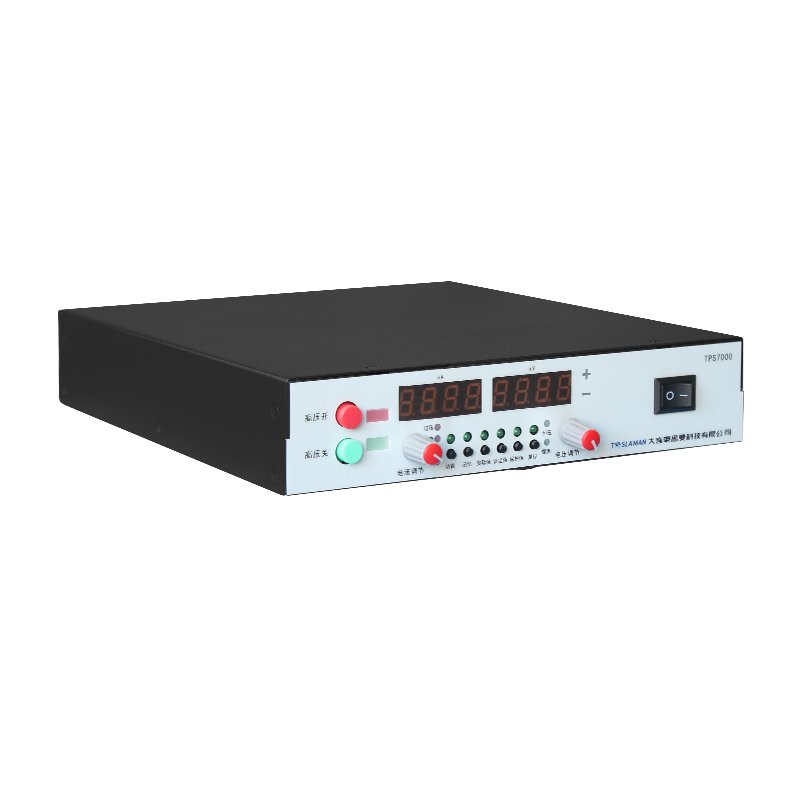
The high-voltage pulse power supply for this application must meet unique demands. First, it must have extremely precise and low-jitter synchronization with the Q-switch or cavity dump of the generation laser, with timing precision in the nanosecond range. The delay between the laser pulse and the high-voltage pulse is a critical parameter; applying the voltage too early or too late relative to the nascent plasma results in weak or erratic enhancement. Second, the pulse shape is important. A fast-rising, short-duration pulse (tens to hundreds of nanoseconds) is typically used to dump energy into the plasma during its initial expansion phase. The supply must be capable of delivering high peak current to sustain the discharge through the low-impedance plasma channel. Third, the system must be designed for high repetition rate operation if rapid scanning is required, which necessitates efficient cooling and robust switching components.
By controlling the amplitude, shape, and timing of the high-voltage pulse, one can precisely tune the characteristics of the generated ultrasound. Increasing the voltage generally increases the amplitude of the broadband ultrasonic signal, improving the signal-to-noise ratio for deep flaw detection. Modulating the pulse shape can influence the frequency content, allowing some degree of spectral shaping to match the ultrasonic attenuation characteristics of the material under test. Furthermore, the spatial configuration of the electrodes can be used to direct the plasma force, offering a degree of directivity to the generated wavefront, which is difficult to achieve with pure thermoelastic generation.
This high-voltage optoacoustic excitation method significantly extends the capabilities of laser ultrasound. It enables the inspection of thicker components, materials with high ultrasonic attenuation like composites or coarse-grained metals, and the detection of smaller, tighter cracks. It allows for one-sided inspection where access is limited. The non-contact nature of both generation and detection makes it ideal for automated in-line inspection in manufacturing or for monitoring components in service at elevated temperatures. Thus, the integration of a precision high-voltage pulser transforms the laser ultrasonic system from a laboratory tool into a robust, field-deployable technology for critical non-destructive evaluation across aerospace, energy, and advanced manufacturing sectors.