The Critical Role of High-Voltage Bias in Accelerator Beam Profile Monitoring with High-Voltage Fluorescent Screens
In the world of particle accelerators, understanding the characteristics of the beam is paramount. You cannot control what you cannot measure. For decades, one of the most direct and visually intuitive methods for beam profiling has been the fluorescent screen. When a beam of charged particles strikes a suitable phosphor material, it emits light, creating an image of the beams spatial distribution. However, the physics of this interaction is not always straightforward, especially for low-energy or high-intensity beams, and this is where the application of a high-voltage bias to the screen becomes a critical enabling technology. My experience in designing high-voltage systems for diagnostics has repeatedly shown that the screen and its bias supply are as integral to the diagnostic as the camera that captures the image.
The primary challenge in beam profiling with a fluorescent screen stems from the emission of secondary electrons. When the primary beam particles impact the screen, they liberate a cloud of low-energy electrons from the surface. If this cloud is allowed to accumulate, it creates a negative space charge potential that repels subsequent primary beam particles, effectively distorting the beam profile. The image on the screen might appear artificially enlarged, dimmer, or even completely suppressed. This is particularly problematic for intense beams or those with a large transverse size. To mitigate this, we apply a high positive voltage, typically in the kilovolt range, to a thin, conductive coating on the screen. This positive potential attracts and sweeps away the secondary electrons, preventing the formation of a space charge cloud and ensuring that the primary beam impacts the screen unimpeded.
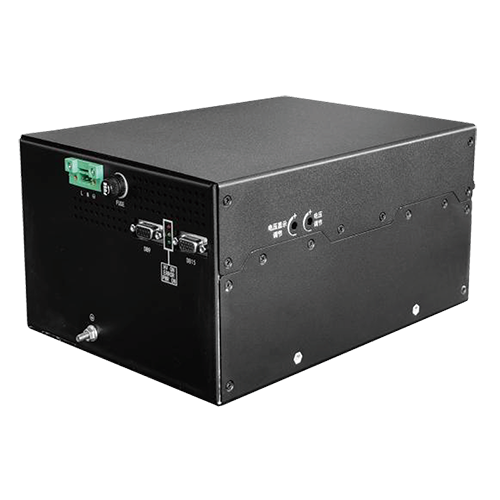
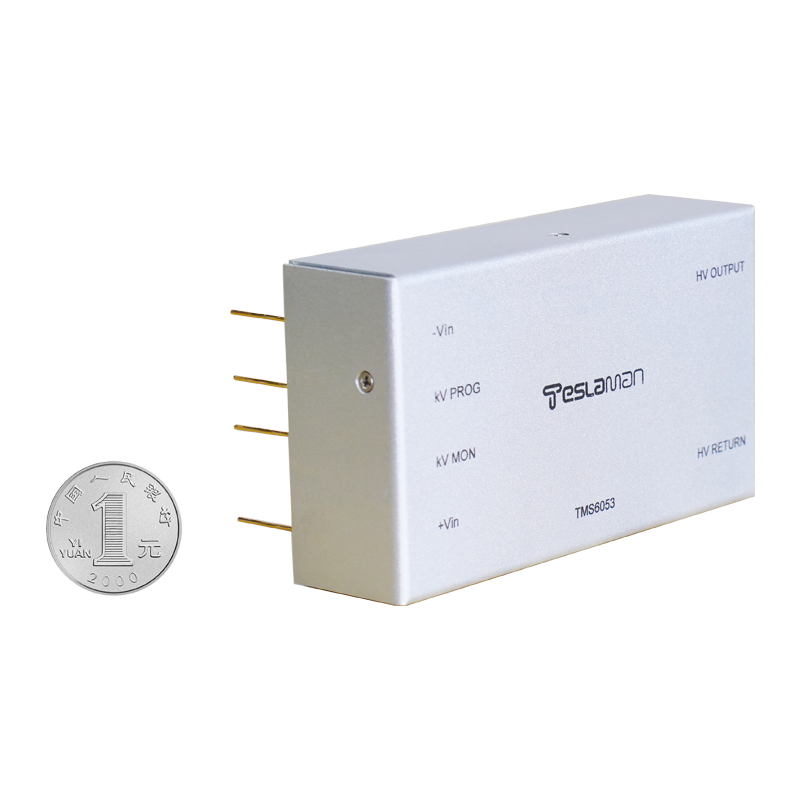
The design of the high-voltage bias supply for such an application must be approached with great care. It is not simply a matter of providing a static DC voltage. The supply must be capable of sourcing the current required to neutralize the secondary electron flux, which can be significant for high-intensity beams. A poor supply with high output impedance will see its voltage sag under this current load, reducing its effectiveness. Furthermore, the screen assembly itself acts as a small capacitor. When the beam is pulsed, the sudden arrival of charge can induce transients on the bias line. The high-voltage supply must have a fast transient response to maintain a stable voltage, or it must be heavily decoupled with local storage capacitance right at the screen feedthrough. This decoupling, however, must be designed with the accelerators vacuum environment in mind, using high-voltage rated, vacuum-compatible capacitors.
Beyond simply clearing secondary electrons, the applied high voltage can be used as a tool for more advanced diagnostics. By varying the bias voltage, we can influence the energy with which secondary electrons are collected, or we can create an electric field that extracts ions from the beam path for residual gas profiling. In some sophisticated setups, a segmented screen with individually biased sections can provide information on the beams position and profile with greater resolution. The high-voltage system then becomes a multi-channel, programmable entity. This requires careful attention to cabling and feedthroughs to prevent cross-talk and high-voltage breakdown. The vacuum feedthrough itself is a critical component, often custom-designed to handle the voltage and to provide a clean, low-outgassing interface. The materials used for insulation must be radiation-hard and resistant to the harsh environment inside an accelerator beamline.
The integration of the high-voltage bias supply with the accelerators control and safety systems is also a non-trivial task. The supply must be interlocked with the beam permit system, so that the bias is present and stable before the beam is allowed to strike the screen. Conversely, if the bias supply faults, it must be able to trigger a fast beam abort to protect the screen from damage, as an unbiased screen can be rapidly destroyed by an intense beam due to local heating and charging effects. The high-voltage cables must be carefully routed and shielded to prevent them from becoming antennas that broadcast noise into nearby sensitive electronics, such as beam position monitors or the cameras used to view the screen. In my years of work, I have seen many a well-designed diagnostic ruined by a noisy or poorly integrated high-voltage bias supply. It is a testament to the fact that in the world of particle accelerators, the humble high-voltage power supply is a precision instrument in its own right, and its role in ensuring the fidelity of beam profile measurements with fluorescent screens is absolutely fundamental to the successful operation of the entire machine.