High-Voltage Correction for Dead Time in Channel Electron Multipliers
Channel Electron Multipliers are the workhorses of particle detection in fields ranging from space science to mass spectrometry. These remarkable devices amplify a single incident electron, ion, or photon into a measurable pulse of millions of electrons through a process of secondary emission within a curved glass channel. However, following the detection of an event, the multiplier enters a period of dead time during which it is insensitive to further particles. This dead time, if uncorrected, leads to counting losses and non-linearities in the detector response. After fifty years in high-voltage engineering, I have learned that the key to correcting for dead time lies not just in post-processing of the data, but in the intelligent manipulation of the high-voltage bias applied to the multiplier itself.
The physics of dead time in a CEM is well understood. After an intense pulse of charge travels down the channel, the walls become depleted of the charge carriers needed for secondary emission. It takes a finite time, typically tens of nanoseconds to microseconds, for this charge to be replenished by the standing current that flows through the resistive wall of the multiplier. During this recovery period, the gain of the multiplier is reduced. If a second particle arrives too soon after the first, it will experience a lower gain and may produce a pulse that falls below the discriminator threshold, going undetected. This is the source of the dead time.
The standard approach to dealing with dead time is to apply a statistical correction to the measured count rate, assuming a known dead time model, such as a paralyzable or non-paralyzable model. This works well for constant count rates but fails when the rate is rapidly varying or when the dead time is not a fixed interval. A more sophisticated approach is to actively compensate for the dead time by manipulating the high voltage during the recovery period.
The gain of a CEM is a strong function of the applied high voltage. A higher voltage increases the secondary emission yield at each stage, resulting in a higher overall gain. Conversely, a lower voltage reduces gain. During the dead time, the channel's wall is depleted. By temporarily increasing the high voltage immediately after a detected pulse, we can boost the gain for any subsequent event that occurs during the recovery period. This boosted gain can compensate for the depleted wall, bringing the pulse height back up to its normal level and allowing the event to be counted. This is the principle of active dead time correction.
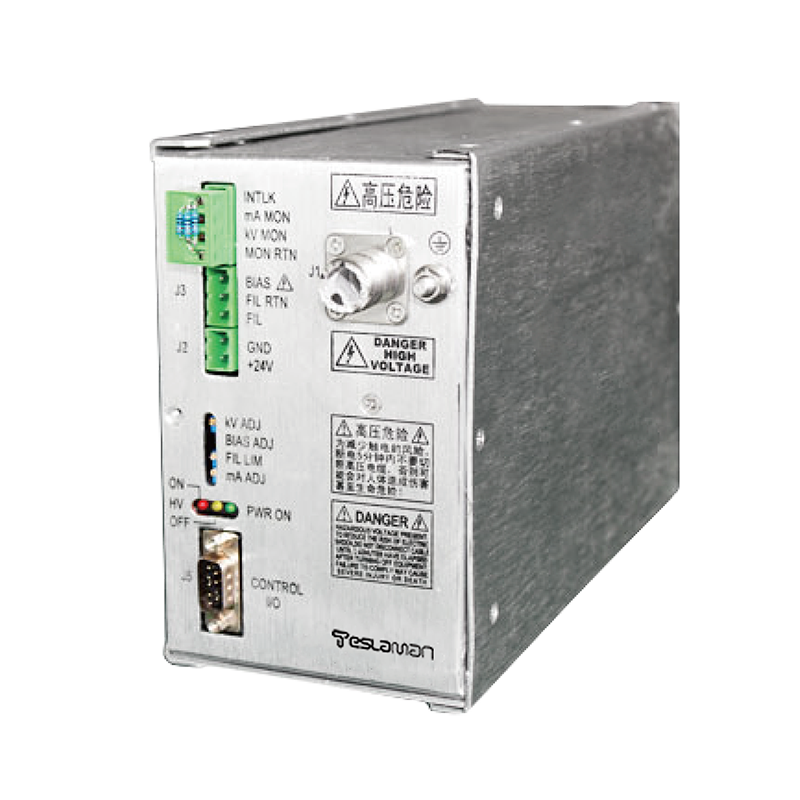
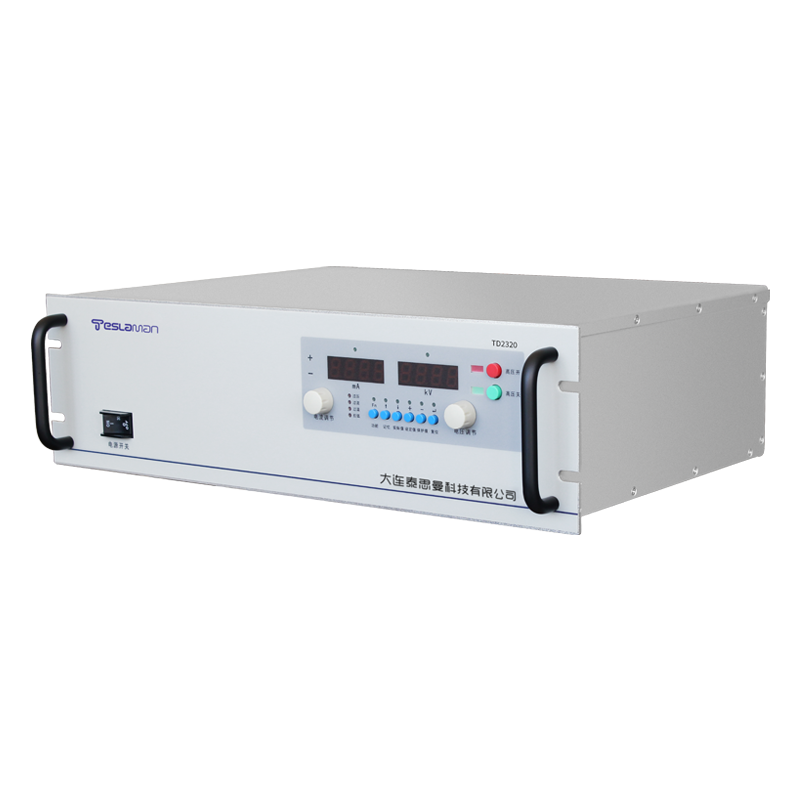
Implementing this requires a high-voltage power supply with exceptional dynamic capabilities. It must be capable of delivering a stable, programmable DC bias, but also of superimposing a precisely timed and shaped boost pulse onto that bias. The boost pulse must be triggered by the detection of an event, which means the power supply must have a fast trigger input. The amplitude and duration of the boost pulse must be carefully calibrated to match the recovery characteristics of the specific CEM. A boost that is too small will not fully correct the gain; a boost that is too large could saturate the multiplier or even cause damage.
The timing of the boost pulse is critical. It must be applied immediately after the event, and its decay must mirror the recovery of the wall charge. This requires a deep understanding of the CEM's transient response. The power supply's output stage must be able to generate a pulse with a fast rise time, a precisely controlled amplitude, and a programmable decay shape, often an exponential decay that matches the RC time constant of the channel wall. Generating such a waveform at kilovolt levels, with nanosecond-scale features, is a formidable challenge in high-speed, high-voltage amplifier design.
Furthermore, this active correction must be applied on an event-by-event basis. If events are arriving in rapid succession, the boost pulses will overlap. The power supply and its control logic must be able to handle this. The system must keep track of the cumulative boost applied and ensure that the voltage never exceeds the safe operating limits of the detector. This requires a sophisticated digital state machine or a fast microcontroller that can calculate the required boost waveform in real-time based on the history of detected events.
Another approach to dead time correction is to use a dual-mode or variable-gain operation. Instead of applying a boost pulse after each event, the average high voltage could be increased as the overall count rate increases. This raises the baseline gain, compensating for the average gain drop due to dead time. This is a simpler technique but is less effective at correcting for the statistical fluctuations in the arrival time of particles.
The feedback for these correction systems can come from the pulse height distribution itself. By monitoring the output of the CEM with a fast analogue-to-digital converter, the control system can measure the actual gain of each pulse. If the gain is seen to be dropping, the high voltage can be adjusted to bring it back to the setpoint. This creates a closed-loop system that actively maintains a constant effective gain, regardless of the count rate. This is the ultimate form of dead time correction, transforming the CEM from a device with a rate-dependent response to one with a perfectly linear output.
In conclusion, the channel electron multiplier is a device whose performance is intimately tied to the high voltage that powers it. The traditional view of the power supply as a simple, constant bias source is obsolete. The modern, intelligent power supply for a CEM is an active partner in the detection process. By generating precisely timed boost pulses or dynamically adjusting the baseline voltage, it can compensate for the fundamental physics of the multiplier's dead time, ensuring that every event is counted with equal efficiency. This high-voltage correction is the key to unlocking the true potential of these sensitive detectors, enabling accurate measurements in the most demanding applications, from single-photon counting to the analysis of complex molecular mixtures.